
Pickori

Practical guide

What CADR Means and How to Read Room-Size Claims

Use smoke, dust, and pollen CADR to compare air purifiers without being misled by oversized coverage numbers.

Blueair Blue Pure 311i Max

Why smoke CADR is useful

CADR is reported in cubic feet per minute. Smoke CADR reflects the purifier's delivery of air cleaned of smaller smoke particles, while dust and pollen figures use different test aerosols.

Smoke CADR is commonly used for sizing because fine-particle control is a central reason to own a purifier. Compare models at their maximum rated setting, then leave noise headroom for everyday use.
CADR is not the fan's raw airflow

A fan can move a large volume of air that is not fully cleaned. CADR accounts for both flow and removal efficiency, which makes it more informative than an unlabeled CFM claim.

The number still comes from controlled testing. Room geometry, open doors, a clogged filter, and reduced fan speed change results at home.

Coverage needs an air-change rate

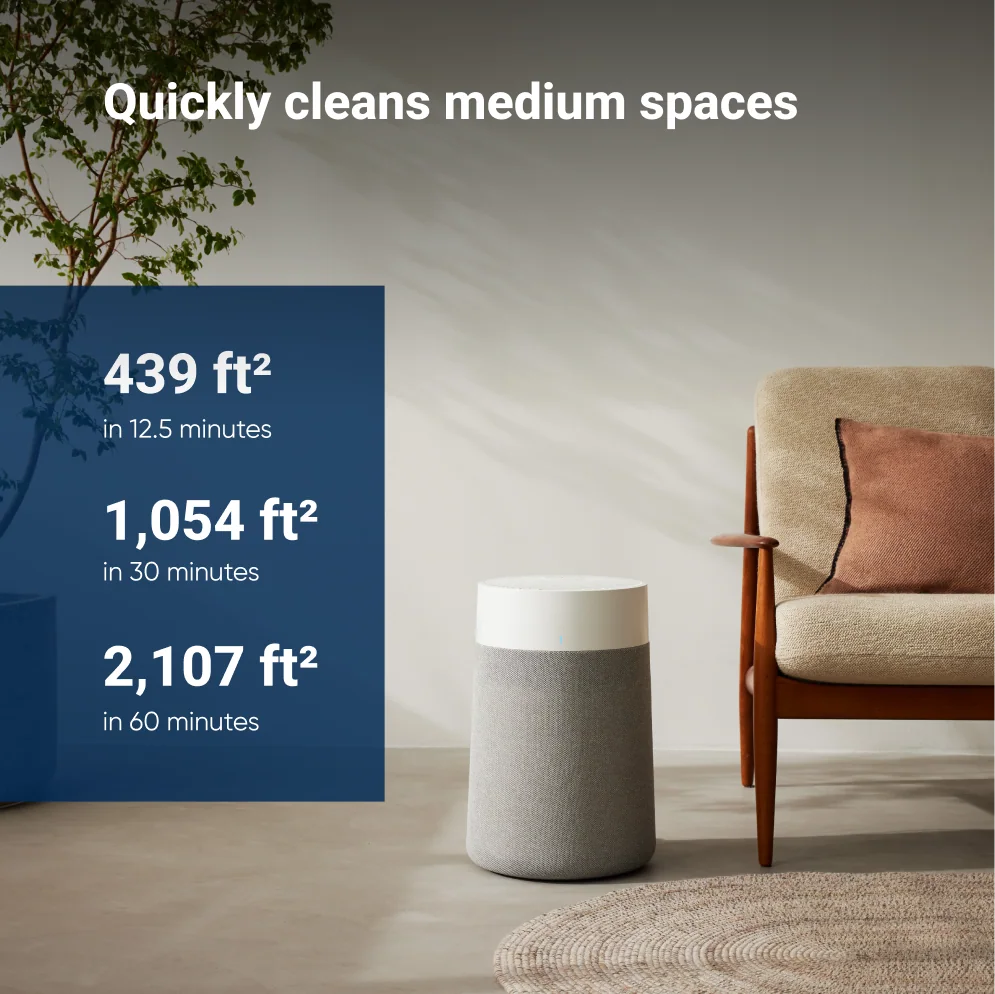
A square-footage claim is incomplete unless it states ceiling height and air changes per hour. The same purifier can claim a modest room at five changes or a huge room at one change.

For smoke and allergens, the higher-change interpretation is the useful one. When brands publish multiple coverage figures, choose the four-to-five-change number for comparison.

What CADR does not tell you

CADR does not price replacement filters, measure app quality, reveal light pollution, or prove that a carbon layer removes gases for a long time. It also does not replace a product-specific safety check.

Use CADR to create a qualified shortlist. Then compare noise, filter support, power use, controls, dimensions, and any optional ionization features.

Products that fit this practical guide

As an Amazon Associate I earn from qualifying purchases.

More from Air Purifiers

← Back to Air Purifiers