
What to know first
- High output for a power bank: up to 140W over USB-C (USB PD 3.1), 250W total budget.
- Large capacity: 27,650mAh (99.56Wh) for longer stretches away from an outlet.
- Three ports lets you charge a laptop and two smaller devices at the same time.
- Front display shows battery status and charging info, not just a vague dot indicator.
- Not pocket-friendly: 659g (23.25oz) is backpack territory.
- Comes with a USB-C to USB-C cable and a carrying pouch (24-month warranty listed).
What the Anker Prime Power Bank (27K, 250W) is
The Anker Prime Power Bank (27K, 250W) is a high-capacity portable charger designed to run more like a laptop power source than a typical phone power bank. The capacity is listed at 27,650mAh, and in watt-hours it’s 99.56Wh. That watt-hour number matters because it’s a more direct way to understand how much energy is actually stored for bigger devices like laptops.
The other big differentiator is output. This model supports USB Power Delivery 3.1 and can deliver up to 140W from USB-C, with a total output budget of 250W. In plain terms: it can push enough power to charge many modern USB-C laptops at a useful speed, not just keep them from dying.
It also has a three-port layout (two USB-C ports and one USB-A port), so you can charge a laptop and still plug in your phone and earbuds without swapping cables all day.
Why it stands out
Most power banks are built around phone charging. This one is built around laptop charging. The Anker Prime Power Bank (27K, 250W) can output up to 140W over USB-C (PD 3.1), which is the level you look for if you want a power bank that can keep up with higher-demand laptops, including larger MacBook Pro models that can take advantage of 140W charging.
The capacity is also unusually high for something meant to be carried. At 99.56Wh, it’s in the range where you can plan on real laptop time, not just a quick emergency boost. For a student, that can mean getting through a long lecture day and study session without playing the outlet scavenger hunt.
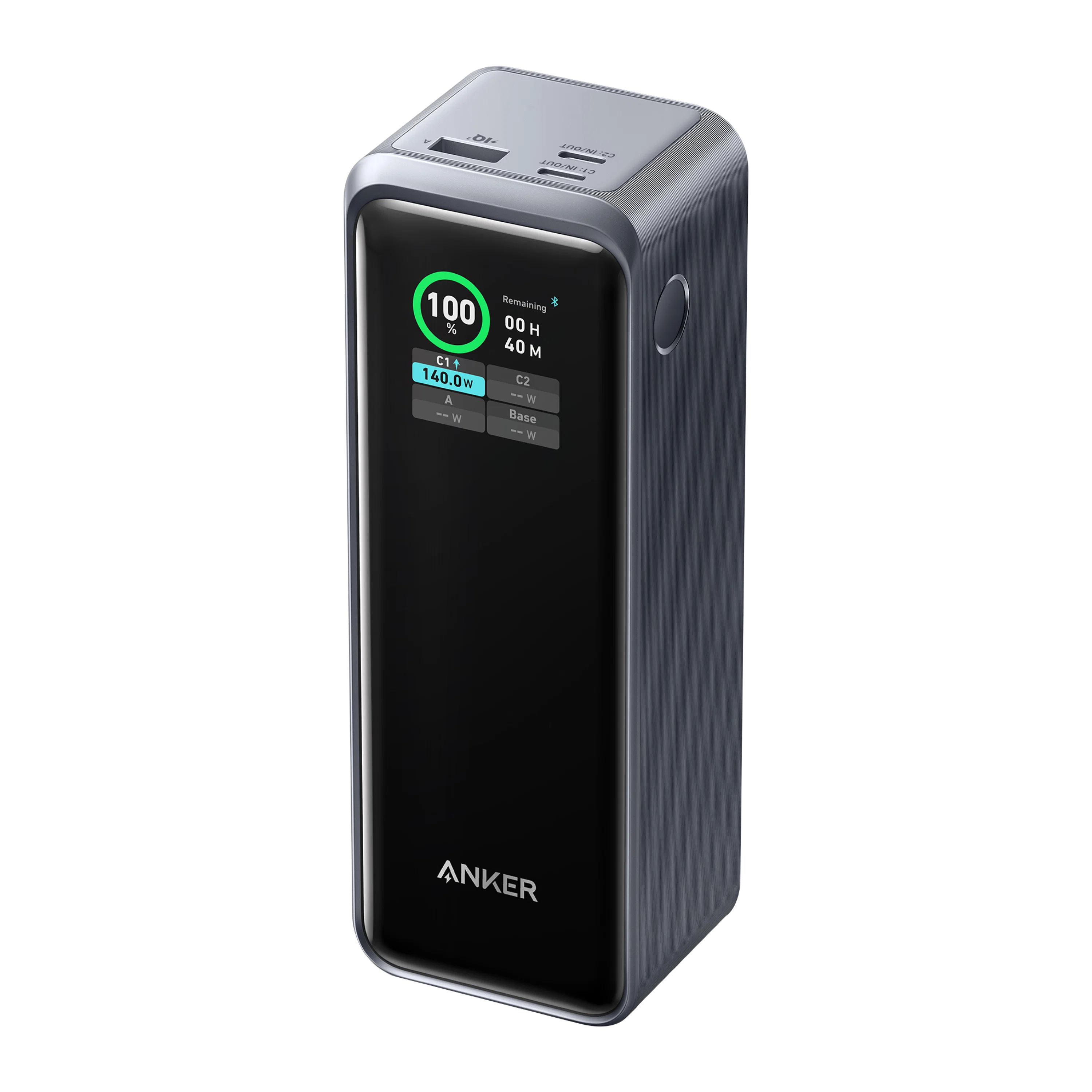
The front display is a practical quality-of-life feature. Instead of guessing based on four LEDs, you get a numeric readout of battery status and charging details. When you’re splitting power across multiple devices, that clarity helps you decide whether to prioritize your laptop, your phone, or both.
Finally, it’s designed to be part of a system. There’s a magnetic connection on the bottom for use with a separate charging base, and there’s app support for monitoring charging stats and locating the power bank with a sound alert.
What it is like to own
Day to day, this is a backpack power bank, not a pocket one. It weighs 659g (23.25oz). That’s the price of getting a 99.56Wh battery and high-wattage output in a portable package. If you’re already carrying a laptop, it’s a reasonable add, but it’s not something most people will want in a jacket pocket.
The port setup is straightforward: three ports on top, with two USB-C ports that can each be used up to 140W, plus a USB-A port. The total output is 250W, but power is shared when you use multiple ports at once. For example, using both USB-C ports at the same time can split to 140W on one and 100W on the other. With all three ports in use, one USB-C can still run up to 140W, the other USB-C up to 92W, and USB-A up to 18W.
Recharging the power bank itself can be fast. Input is listed up to 170W, and it can be recharged using the two USB-C ports at the same time. There’s also an optional charging base sold separately that provides a more dock-like experience and adds extra ports on the base itself.
In the box, it comes with a USB-C to USB-C cable and a carrying pouch. The warranty is listed as 24 months.
What to know before you buy
First, this is a premium power bank with a premium price. If your main goal is charging a phone a couple times, you can spend far less and get a smaller, lighter battery that’s easier to live with. The Anker Prime Power Bank (27K, 250W) makes the most sense when you actually need laptop-level output and a big battery.
Second, the size and weight are real. At 659g, you’ll notice it in a small backpack, and it’s not something you’ll casually carry every day unless you routinely need it. Think of it like carrying a spare laptop charger plus a battery, combined into one brick.
Third, if you’re buying it because you want the magnetic charging base experience, plan for that as a separate purchase. The base is not included.
The specs that matter
This is the difference between a phone-only power bank and one that can meaningfully charge a laptop. The watt-hour figure is especially useful for understanding laptop charging potential.
Higher wattage means your laptop can charge at a more normal pace instead of slowly creeping up (or just holding steady) while you use it.
You can charge multiple devices at once without everything dropping to a trickle. It’s built for laptop plus phone plus accessories.
You can keep a laptop plugged in and still charge your phone and earbuds without swapping cables between classes or on a flight.
It helps you plan. You can fast-charge one laptop while still charging a second device, but the wattage isn’t unlimited on every port at the same time.
A big power bank is only convenient if it doesn’t take forever to refill. Higher input means you can top it back up faster with a capable USB-C charger.
This is the main ownership downside. It’s fine in a backpack, but it’s not an everyday pocket carry.
You can use it out of the box, and the pouch helps keep the brick and cable from beating up your bag.
Who this product fits
All-day campus schedule with a laptop
If you’re bouncing from lecture to lab to the library, the Anker Prime Power Bank (27K, 250W) can keep a USB-C laptop charging at high wattage and still leave ports open for your phone and earbuds. The numeric display makes it easier to ration power across the day.
Long flight or train ride with multiple devices
Instead of hoping your seat outlet works, you can run your laptop from USB-C while also charging your phone. With a 99.56Wh battery, it’s built for extended time away from a wall plug.
MacBook Pro owner who wants true fast charging from a power bank
With up to 140W USB PD 3.1 available on USB-C, this power bank is designed to support higher-demand MacBook charging. If you use Apple’s USB-C to MagSafe 3 cable, you can take advantage of fast-charging behavior supported by compatible MacBooks.
Shared power in a group study session
Three ports and a 250W total output budget makes it realistic to charge a laptop and two smaller devices at the same time, so you’re not passing around one cable or fighting over the only outlet.
Anker Prime Power Bank (27K, 250W) FAQ
Can the Anker Prime Power Bank (27K, 250W) charge a laptop?
Yes. It supports USB Power Delivery 3.1 and can output up to 140W over USB-C, which is intended for charging many USB-C laptops at useful speeds. It also has enough capacity (99.56Wh) to make laptop charging worthwhile.
How many devices can the Anker Prime Power Bank (27K, 250W) charge at once?
Up to three devices at once. It has two USB-C ports and one USB-A port, and it’s designed to share power across them depending on what you plug in.
Does it really output 140W on both USB-C ports at the same time?
Each USB-C port is capable of up to 140W, but the total output is shared when multiple ports are used. With both USB-C ports in use, one can run at 140W while the other runs at 100W.
Is the Anker Prime Power Bank (27K, 250W) allowed on airplanes?
Its capacity is listed as 99.56Wh. Many airlines set limits based on watt-hours, so this number is the one you’d check against your airline’s current rules before flying.
What comes in the box with the Anker Prime Power Bank (27K, 250W)?
It comes with a USB-C to USB-C cable and a carrying pouch. A 24-month warranty is listed.
Does it come with the magnetic charging base?
No. The power bank has magnetic connectors designed to work with a separate charging base, but that base is sold separately.
Should you buy the Anker Prime Power Bank (27K, 250W)?
Buy the Anker Prime Power Bank (27K, 250W) if you regularly carry a laptop and you’re tired of planning your day around outlets. The combination of 27,650mAh (99.56Wh) capacity, up to 140W USB-C output, and three-device charging is exactly what makes a power bank feel like a real backup power source instead of a phone accessory.
Skip it if your world is mostly phone charging. The weight (659g) and the premium price only make sense when you’ll actually use the laptop-level power. If you will, this is a practical piece of gear that can keep your whole setup running through long campus days and travel.