
The short version
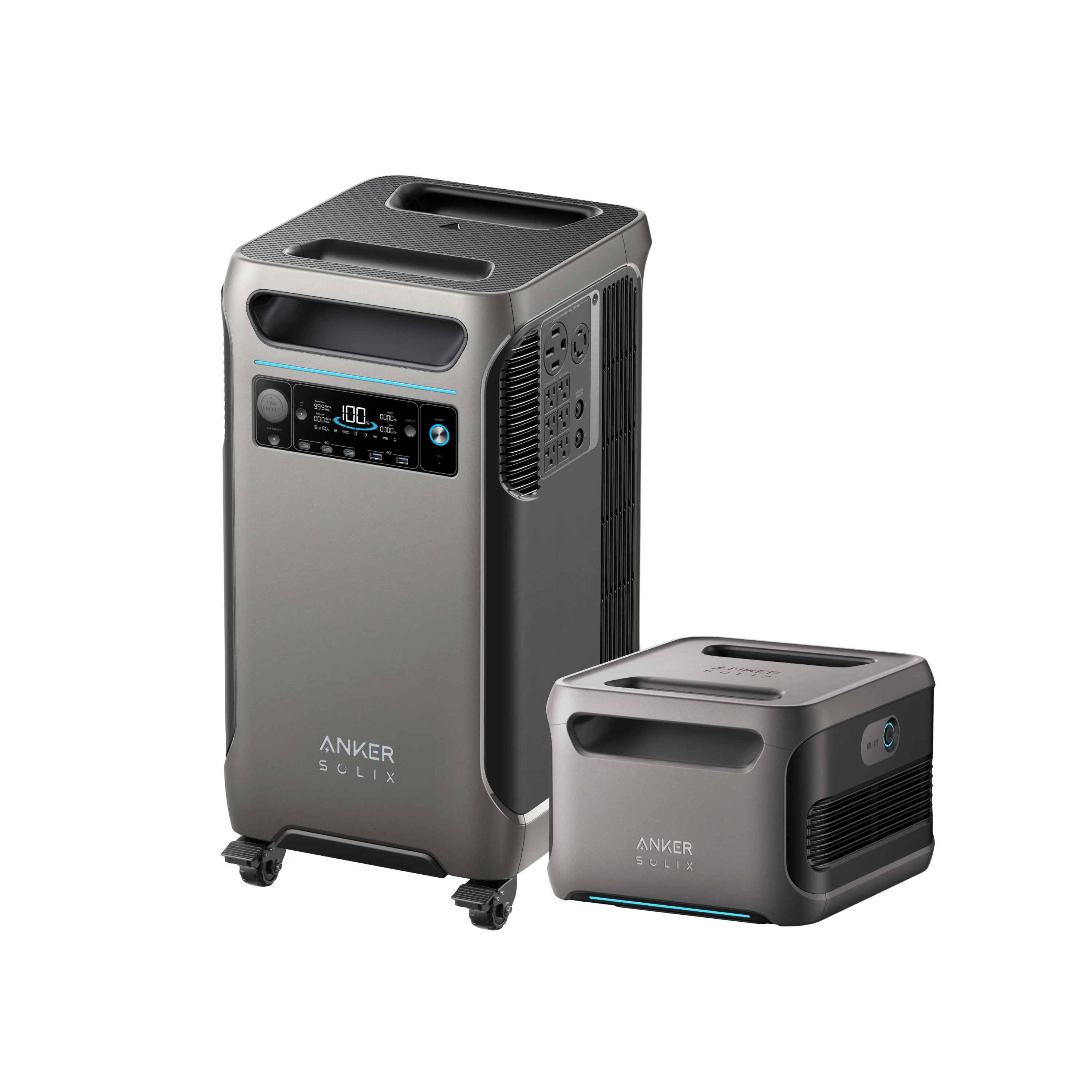
Think of the F3800 as a very large rechargeable battery with its own wall-style outlets. The base unit does not automatically power your house. During an outage, it supplies electricity only to the appliances and devices you connect to it.
You can use it on its own for a refrigerator, lights, internet equipment, phones, and other priorities. Or you can add compatible home-backup hardware so it feeds selected circuits through your breaker panel. That second setup is what lets chosen lights, outlets, and appliances keep working in their usual places instead of relying on cords running back to the power station.
What must the power station run at the same time, and how long must it run? Output answers the first question. Battery capacity answers the second.
Capacity and output are not the same thing
Think of battery capacity as the size of a fuel tank. The F3800 stores 3,840 watt-hours, or 3.84 kilowatt-hours, of energy. More capacity generally means more runtime.
Output is closer to the size of the engine. The F3800 can supply 6,000 watts continuously, which tells you how much equipment it can power at one time. Its 9,000-watt surge rating is a short burst for appliances that briefly need extra power when a motor or compressor starts.
A large output number does not guarantee long runtime. If several appliances pull 3,000 watts continuously, they can drain the base battery in a little over an hour before real-world losses. A refrigerator normally uses far less because its compressor turns on and off instead of drawing full power continuously.
Calculated runtime examples
| Average load | Theoretical runtime | What that might represent |
|---|---|---|
| 100W | 38.4 hours | Internet equipment, lights, and small electronics |
| 500W | 7.7 hours | A moderate mixed load or cycling appliance |
| 1,500W | 2.6 hours | A sustained high-draw appliance |
| 3,000W | 1.3 hours | Multiple large loads running together |
| 6,000W | 0.64 hours | The station's full continuous output |
These are simple calculations based on 3,840Wh divided by average load. Real runtime will be lower because the station uses some energy to convert battery power into wall-outlet power. Standby use, temperature, battery condition, and changing appliance loads also affect the result.
What the F3800 actually does during an outage
Imagine the utility power fails at 9 p.m. Your refrigerator stops cooling, the Wi-Fi goes down, the lights go dark, and your phones are already running low. The F3800 gives you a stored supply of electricity so those problems do not all become emergencies at once.
With only the base unit, you roll it into position, turn it on, and plug in what you want to keep running. The refrigerator can connect directly when practical; if distance requires an extension cord, it needs to be properly rated for the appliance and used according to both manufacturers' instructions. A lamp, router, phone chargers, and another priority device can use the remaining outlets. Anything still connected only to a dead household outlet remains off.
That is the practical reason to own one: it can keep food cold, restore basic lighting and communication, and give you useful household power while you decide whether the outage will last minutes or days. You can also see how much electricity you are using and preserve the battery by running optional high-draw appliances only when needed.
Never try to feed the F3800 into normal household wiring through a standard receptacle. A home connection requires compatible transfer equipment and proper installation by a qualified professional. The battery is also finite: the more equipment you run, the faster its stored energy is used.
The six standard 120V outlets work like the wall outlets most people use every day. The additional 240V connections support compatible higher-power equipment. The NEMA 14-50 outlet is commonly used with RV and EV equipment, while the L14-30R connection can be part of a compatible home-backup setup.
Charging, solar, and expansion
The original F3800 accepts up to 1,800 watts from a US wall connection and up to 2,400 watts from a compatible solar setup. Those input numbers describe how quickly power can flow back into the battery, not how much energy the battery stores. Actual solar charging depends on the panels, wiring, weather, and available sunlight.
It can connect to as many as six BP3800 expansion batteries for up to 26.9kWh of stored energy. Anker also supports a two-unit configuration that can reach 12kW of output and 53.8kWh with expansion batteries. In plain terms, extra batteries buy more runtime, while a second F3800 can also increase the amount of equipment the system can run at once.
Those maximum configurations are expensive, but you do not have to buy the full system at once. You can start with the base unit, learn how much power your essentials actually use, and add batteries if the runtime is not enough.
What it is like to own
The telescoping handle and wheels matter because this unit weighs 132.3 pounds. Rolling it across a smooth garage floor is reasonable. Carrying it up stairs, lifting it into an SUV, or moving it over rough ground is not. It needs a planned storage location with enough room for a body measuring roughly 27.6 by 15.3 by 15.6 inches.
The F3800 has Wi-Fi and Bluetooth control, three 100W USB-C ports that can charge many laptops, and two USB-A ports. Its under-20ms UPS specification means it can switch from wall power to battery power very quickly when an outage begins. That may keep many connected electronics running through the changeover, although compatibility still depends on the device.
It uses long-life LFP battery chemistry and carries a five-year warranty. Anker rates the battery for more than 3,000 cycles, meaning thousands of substantial charge-and-discharge sessions before normal aging becomes the larger concern. The unit is not waterproof, so it still needs a covered, dry operating and storage location.
F3800 or F3800 Plus?
Anker now sells the newer F3800 Plus. The original F3800 can still be the better value when discounted, but the Plus deserves a direct price comparison before you buy. Its upgrades include higher maximum solar input and generator-bypass support, features that matter most to buyers building a more complete home-backup system.
If the price gap is small and you expect to recharge from solar or a generator during longer outages, the newer model is easier to justify. If the original F3800 is substantially less expensive and its existing charging setup already covers your plan, its core 6,000W output and 120V/240V flexibility remain compelling.
Pros and cons
What we like
- 6,000W continuous output from one unit
- Native 120V and 240V connections
- Useful home, RV, and emergency EV support
- Large expansion path without requiring every battery up front
- Long-life LFP battery chemistry and a five-year warranty
What to consider
- 132.3 pounds makes portability conditional
- The base battery can drain quickly under very high loads
- A complete home setup adds cost and complexity
- It is not waterproof
- The newer F3800 Plus should be compared before paying full price
Anker SOLIX F3800 specifications
| Battery capacity | 3,840Wh, or 3.84kWh, of stored energy |
|---|---|
| Battery chemistry | LFP, a long-life chemistry rated for 3,000+ cycles |
| Continuous / surge output | 6,000W for ongoing use and 9,000W briefly when equipment starts |
| Voltage support | Standard 120V equipment plus compatible 240V equipment |
| Maximum solar input | Accepts up to 2,400W from a compatible solar setup |
| US AC input | Accepts up to 1,800W when charging from AC power |
| Expansion | Up to six BP3800 batteries for 26.9kWh total capacity and longer runtime |
| Weight | 132.3 pounds |
| Dimensions | 27.6 x 15.3 x 15.6 inches, including wheels |
| Wireless control | Wi-Fi and Bluetooth |
| Warranty | 5 years |
Who should buy the Anker SOLIX F3800?
Buy it if you are preparing for household outages, need to run higher-draw 120V or 240V equipment, want an RV-friendly power source, or expect to add batteries and a home connection over time. It is especially sensible for a garage-based backup plan where the unit can stay on one level and roll into position when needed.
Choose a smaller power station if your priority is tent camping, frequent car travel, easy lifting, or charging phones and laptops. Choose a permanently installed battery if you want seamless whole-home operation and do not need the flexibility of a movable system.
Frequently asked questions
Can the Anker SOLIX F3800 power a house?
Out of the box, it powers the appliances you plug directly into it. With separate compatible transfer equipment or an Anker Home Power Panel, it can supply selected circuits through the home's breaker panel. It does not simply plug into a normal wall outlet and energize the whole house, and its 3,840Wh base battery still limits how long those loads can run.
Can the F3800 run 240V appliances?
Yes. It provides standard 120V power and 240V power through NEMA 14-50 and L14-30R connections. The equipment must use a compatible connection, and its normal and startup power requirements must stay within the F3800's limits.
How long will the F3800 run a refrigerator?
There is no single reliable number because refrigerator size, efficiency, room temperature, and compressor cycling vary. Check the refrigerator's average energy use rather than relying only on the highest wattage printed on its label. The 3,840Wh battery is the starting point, and real runtime will be lower after conversion losses and normal operating variation.
Can the F3800 charge an electric vehicle?
It has a NEMA 14-50 connection that supports emergency EV charging. The base battery is better viewed as a way to add limited range in a pinch, not as a replacement for a normal home or public EV charger.
Is the F3800 really portable?
It is movable, but not easily carried. The wheels and telescoping handle make it practical on smooth, level surfaces. At 132.3 pounds, stairs and vehicle loading are a two-person problem for many households.
Final verdict
The Anker SOLIX F3800 is a serious portable power station for buyers whose backup plan extends beyond phones, lights, and a small refrigerator. Its 6,000W output and native 240V support are the reasons to buy it. Its 132.3-pound weight and 3,840Wh base capacity are the reasons to plan carefully before you do.
For a garage-based outage system with room to expand, it is an excellent foundation. For casual camping or frequent transport, it is far more power station than most people need.