
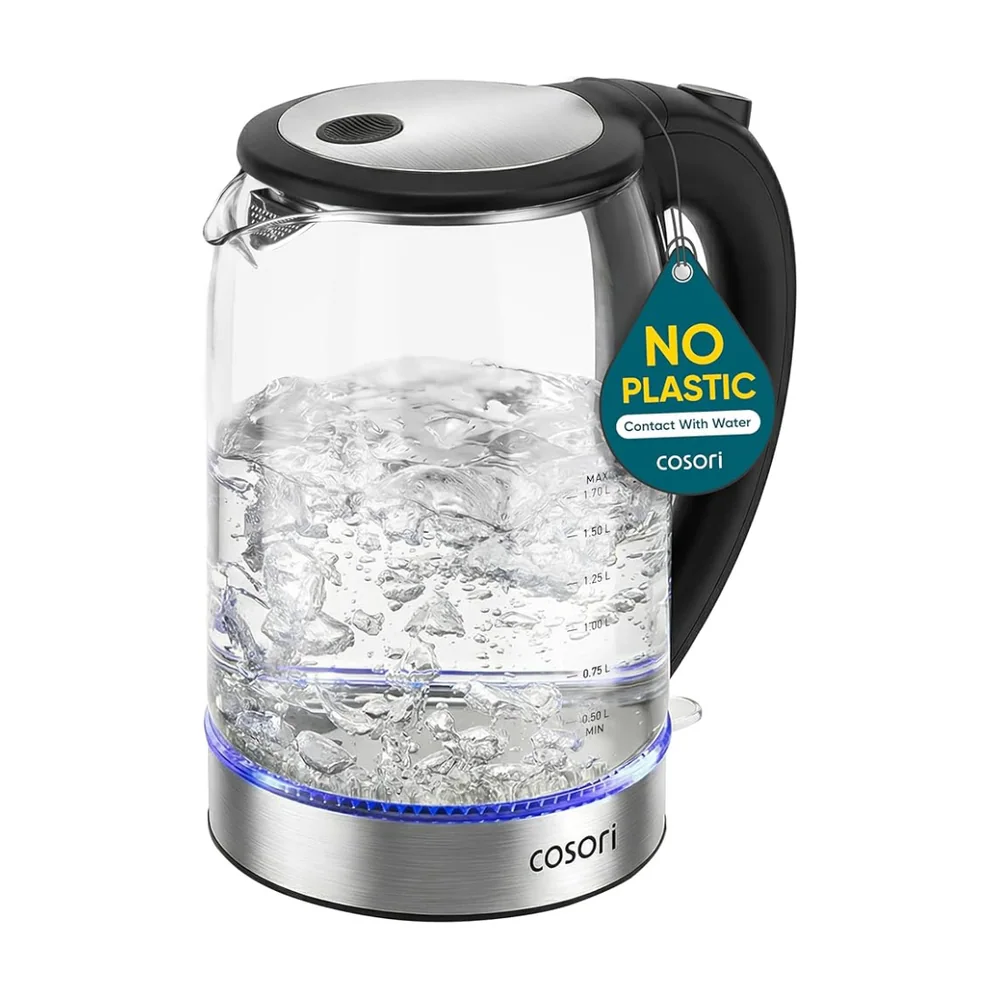
Pickori's Take
- The Cosori Electric Glass Kettle is the glass kettle to buy at $29.99 for simple, visible boiling. It has no temperature dial and no keep-warm setting, so anyone who needs precise lower temperatures or repeatable specialty coffee water should look at a different model.
- Cosori says water contacts borosilicate glass and stainless steel rather than plastic. That does not make the entire appliance plastic-free; the handle, lid housing, and base still use plastic outside the water path.
- A full 1.7 L kettle weighs roughly 6.45 pounds once water is added to the 2.7-pound empty body, worth planning around if wrist strength or one-handed pouring is a concern.
- A related European G173 family test reported an accurate pour, a stable base, and easy cleaning. Those observations make the shared design promising, but they do not prove identical US performance.
- Mineral scale is easy to see against clear glass. Cosori gives vinegar, lemon-juice, and baking-soda descaling methods, and frequent users should expect regular upkeep.
- A two-year limited warranty and a $29.99 direct price make this an easy recommendation for boiling duty, provided you're not expecting presets or a keep-warm hold at that price.
Where the Cosori sits among glass electric kettles
Cosori's CGK-G173-KUS is deliberately simple. At $29.99 direct from the brand, it pairs a 1.7 L borosilicate glass body with a 1,500-watt heater built for 120-volt US outlets. There is no display, temperature menu, or app to learn.
Cosori's manual calls the capacity seven US cups, though a single drink usually needs much less. The kettle measures 10.3 by 8.7 by 5.9 inches and weighs 2.7 pounds empty. This review covers the black CGK-G173-KUS configuration.
A blue light shows when the heater is running, a spring-loaded lid opens for filling and cleaning, and a 304 stainless-steel filter sits at the spout to intercept loose particles. The filter does not remove dissolved minerals; descaling is what addresses deposits inside the kettle.
CHIP's independent evaluation of a related European G173 model reported a stable base, accurate pouring, and easy cleanup. Shared body geometry makes those observations relevant, but regional power differences and normal unit variation mean they are supporting context, not a promise that every US kettle will behave identically.
The no-plastic water path, and why it actually matters here
Cosori's specific claim for this model is that water does not contact plastic inside the kettle. The glass body, stainless-steel heating plate, and stainless filter form the water path. That is narrower than calling the appliance plastic-free, because the handle, lid housing, and base still use plastic outside the water path.
That distinction is the real reason to choose this over a visually similar budget kettle. Buyers concerned about plastic touching drinking water get a clear, model-specific answer without pretending every exterior component is metal or glass.
The clear body also turns fill level and mineral buildup into visible information. You can see how much water is inside before lifting and spot deposits before they become a surprise. The tradeoff is fragility: the glass is not shatterproof, and a hard impact or drop can end the kettle's useful life.
The dual-angle lid is a smaller compromise. In CHIP's related-family test, the spring lid opened partway on its own and needed a hand to swing fully open. Partial opening can limit splash during a quick fill, while full opening creates better access for cleaning. It is functional, but not a completely one-handed design.
What the Cosori actually does well, cup by cup
This is a 1,500-watt, 120-volt US kettle with a 1.7 L borosilicate tank and no temperature dial. Its performance story is strongest on small pours and clearest about what it cannot do.
| Workload | Outlook | What to expect |
|---|---|---|
| Heating two cups for a single mug of tea or coffee | Fast and low-effort | Cosori rates 0.5 L, about two cups, at under three minutes on this heater. A small fill also means a light kettle to lift, which is where this machine feels its best. |
| Filling a French press or pouring for two or three people | Capable, with a heavier lift | Pushing toward the 1.7 L line brings the kettle close to 6.45 pounds of glass and water. The wide mouth makes it easy to fill from a faucet or pitcher, but the pour itself asks more of your wrist than a half-full kettle does. |
| Brewing delicate teas at a controlled lower temperature | Not the right tool | There is no temperature selection and no way to stop the heater short of a full boil. Leaves that want gentler water need a kettle with adjustable temperature, not this one, since the heater simply doesn't offer a lower stopping point. |
| Heating water repeatedly while cooking | Well suited to simple boiling tasks | Automatic shutoff ends each boil without a separate timer, while the wide opening makes refilling straightforward. The kettle still needs the stated minimum fill and a closed lid for normal operation. |
| Tracking mineral buildup in a hard-water kitchen | Genuinely useful | Scale is visible through the glass instead of hidden inside an opaque body. That makes it easier to respond to buildup using Cosori's manual-backed descaling routine. |
| One-handed pouring for someone with limited grip strength | Plan for two hands | A near-full kettle weighs roughly 6.45 pounds. Someone with limited grip strength may prefer a smaller fill, a two-handed routine, or a lighter kettle. |
The useful way to read this kettle's performance is to separate the US model from a European test of the related G173 family. CHIP Testcenter measured one liter at 3 minutes 21 seconds, with a measured 1,844-watt draw and 101 Wh used on 220 to 240 volt mains. The US CGK-G173-KUS is rated at 1,500 watts and 120 volts, so neither that boil time nor that energy result should be treated as a US prediction. Cosori's own US claim is narrower: 0.5 L heats in under three minutes.
The European test is more helpful on physical behavior. Its sample poured accurately, sat securely on its base, and was easy to clean. It also measured 68.4 C after 30 minutes without an active keep-warm mode. Those are useful observations from a related design, not guarantees for every US unit or every room and starting temperature.
Where this kettle reaches a firm limit is temperature control. There is no dial, preset, or keep-warm hold. That is appropriate for drinks and foods that call for boiling water, but it is a poor fit when a tea or coffee routine depends on a repeatable lower temperature.
At $29.99, the boundary is easy to understand. Cosori spends the budget on the glass body, stainless water-contact surfaces, wide opening, and basic safety functions. Buy it for those fundamentals, not as a substitute for a temperature-control kettle.

While you're comparing
The right product, at a better price
Our free morning email rounds up discounts worth knowing about, from kitchen upgrades to everyday tech. Reviews and buying guides arrive separately in our occasional newsletter.
Free to joinUnsubscribe anytime
Filling, boiling, and living with a glass kettle day to day
The wide mouth makes filling from a tap or filter pitcher straightforward. Cosori requires water to reach at least the MIN line before heating, but the supplied US manual does not give an exact minimum volume. Follow the line rather than guessing.
Filling to the 1.7 L maximum every time adds weight that most single servings do not need. A roughly 6.45-pound full kettle places much more load on the wrist during a tilted pour than a half-full one. Fill for the task, not for the capacity printed on the box.
The kettle is hand-cleaned, not dishwasher-cleaned or immersed. Clear glass makes scale easy to see, and Cosori provides three descaling choices: equal parts vinegar and water, 50 mL lemon juice with 500 mL water, or 5 mL baking soda with 500 mL water. Boil the mixture, let it sit 15 to 30 minutes, rinse, and run a clean-water boil before normal use.
Automatic shutoff and boil-dry protection are backup safeguards. Normal operation still requires a closed lid and unobstructed spout and switch-area vents. Stop using the kettle if the glass body, cord, or base is damaged, or if shutoff becomes unreliable.
The one decision this kettle makes for you
Every feature this kettle skips traces back to one choice: boil, and only boil. There is no temperature dial, no preset, and no keep-warm hold. That is not a hidden omission; it is the product's defining boundary.
Black tea, many herbal drinks, French press, oatmeal, instant noodles, and cooking tasks can fit a boil-only routine. Temperature-sensitive teas and repeatable specialty-coffee recipes are better served by a kettle that can stop at a selected lower setting.
Glass creates a second boundary. A full kettle is heavy, and a dropped glass vessel is less forgiving than a non-glass alternative. This is an easy trade in a careful kitchen and a harder one in a busy shared space or for someone whose grip strength makes a 6.45-pound tilted pour uncomfortable.
Those limitations make the recommendation more useful, not weaker. Buy the Cosori when visible water, the stated stainless-and-glass water path, and a fair price matter more than presets. Choose something else when control, low lifting weight, or impact resistance matters more.
How much kettle are you actually lifting at 1.7 liters?
The number on the box, 1.7 liters or seven US Cups, undersells what you're holding once that water is actually in the kettle. Water weighs close to one kilogram, about 2.2 pounds, per liter, so 1.7 liters adds roughly 3.75 pounds on its own. Add that to the kettle's 2.7-pound empty weight and a maxed-out fill comes to about 6.45 pounds before you tilt it forward to pour anything.
The total is not alarming, but it changes the pour. Tilting nearly 6.5 pounds of hot water asks more of the wrist and forearm than pouring from the same kettle half full. The sensible response is to use the capacity only when the task requires it.
Pickori's rule of thumb here is simple: fill for the task, not for the line. If you're making two mugs of tea, fill to roughly a third or half of the tank rather than topping off to MAX out of habit. Reserve a full or near-full fill for genuine multi-person situations, a French press for the table or a pot of oatmeal for the family, where the extra capacity is actually doing work rather than just adding weight to a short pour.
Anyone with reduced grip strength or a wrist injury should treat full weight as a purchase criterion, not a footnote. This kettle can still work with smaller fills, but a lighter model may be the better everyday choice.
Do you need a dial, glass, or just a boil?
The honest question before buying this kettle is what's actually in your cup most mornings. If the answer is black tea, herbal tea, French press coffee, oatmeal, instant noodles, or hot water for cooking, a boil-only kettle isn't a compromise at all, it's the correct tool already doing the one job those drinks and dishes need.
If your routine depends on a repeatable lower temperature, working around a boil-only kettle adds friction every time. Cuisinart's CPK-17P1 is the more feature-rich choice because it adds selectable temperature settings and a keep-warm mode. Buyers who want to stay with a glass body can also compare the OXO Brew Cordless Glass as a more premium boil-only alternative.
Glass is a separate decision. It shows fill level and mineral scale clearly, but it is heavier at full capacity and vulnerable to breakage. Hard water sharpens both sides of that trade because deposits are easy to spot and difficult to ignore.
Choose this Cosori for boil-only simplicity, visibility, and its stated stainless-and-glass water path. Choose a preset kettle when lower temperatures are central to the routine, or a non-glass body when breakage risk outweighs visibility.
Who this product fits
The daily black tea drinker who just wants a clean boil
This is close to the ideal buyer. A full rolling boil is exactly what black tea, rooibos, and most herbal blends want, and the stainless-and-glass water path means nothing gets between the water and the cup. Filling to a third or half of the tank each morning keeps the pour light and the routine simple.
The green tea or delicate-leaf drinker shopping on a budget
Skip this one if lower-temperature control is part of the daily routine. A preset kettle such as the Cuisinart CPK-17P1 solves that problem with selectable settings and a keep-warm mode, though it occupies a more feature-rich class than this basic Cosori.
The hard-water household that hates discovering scale too late
Glass turns mineral buildup into something you can see early. Paired with Cosori's descaling instructions, that visibility can make maintenance more timely, but it also means deposits remain on display until you clean them.
The shared or high-traffic kitchen with careless handling
A roughly 6.45-pound glass kettle at full capacity is a poor fit when many people handle it casually. A non-glass kettle removes the glass-breakage concern, while a smaller-capacity model can reduce the full lifting weight.
What else to compare
A couple of nearby options cover the two things this Cosori deliberately skips: selectable temperature and premium glass build.
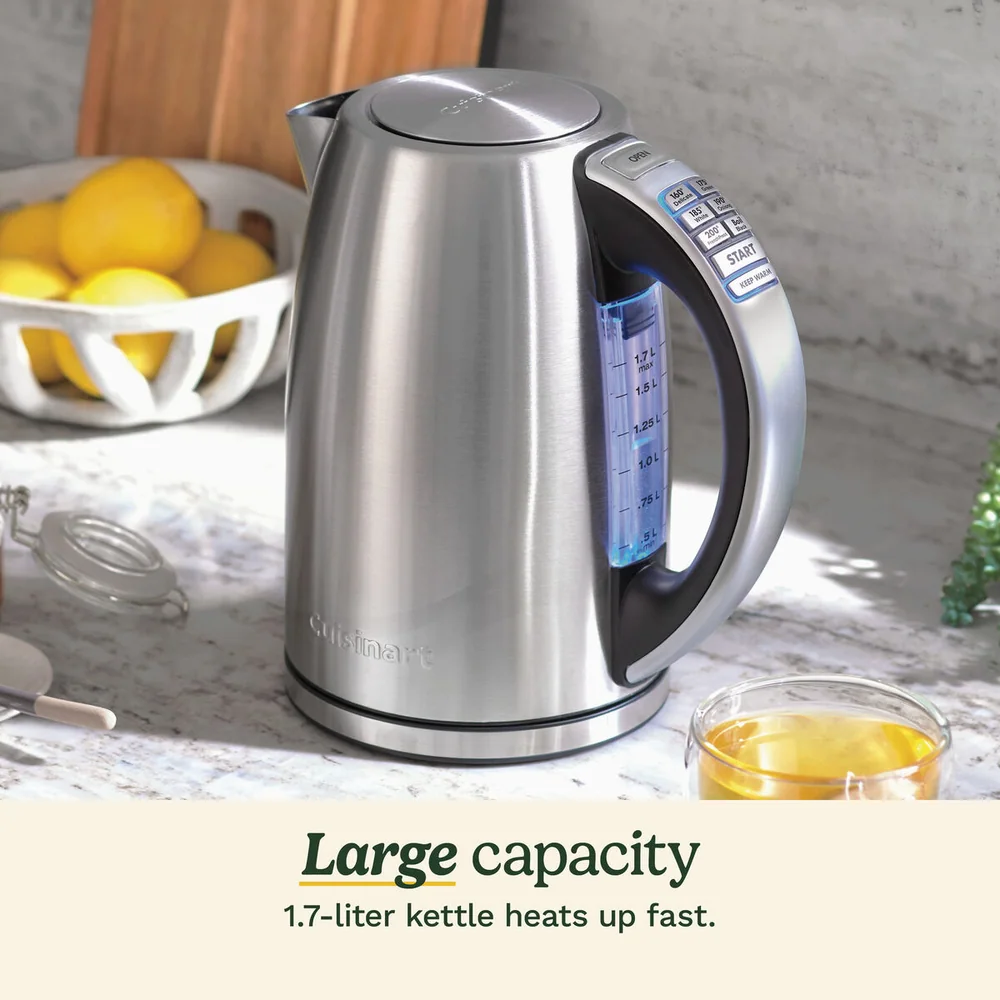 Cuisinart CPK-17P1 PerfecTemp Cordless Electric KettleThe better fit for mixed tea and coffee routines because it adds six temperature presets and a 30-minute keep-warm mode
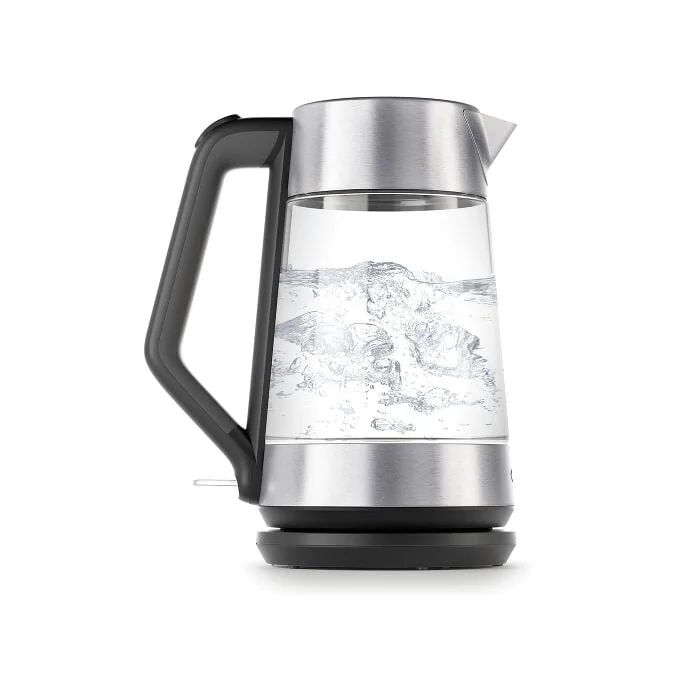 OXO Brew Cordless Glass Electric KettleA more premium glass alternative for shoppers willing to spend more for OXO's ownership details
Cosori Electric Glass Kettle FAQ
Is the Cosori Electric Glass Kettle plastic-free?
No, and Cosori doesn't claim that. The specific claim is that water never contacts plastic, thanks to a borosilicate glass body, a stainless-steel heating plate, and a stainless filter. The handle, lid housing, and base still use plastic, just not anywhere the water touches.
Does the Cosori kettle automatically shut off?
Yes. It shuts off automatically after a normal boil and includes boil-dry protection if it is switched on without water. Those are backup safeguards, not substitutes for filling to the marked minimum line and keeping the lid closed during operation.
Is it dishwasher safe?
No. Cosori says not to submerge the kettle body or power base. Clean it by hand, keep the electrical components dry, and use the manual's descaling process for mineral deposits.
How do you descale the Cosori kettle?
The manual offers three options: equal parts white vinegar and water, 50 mL lemon juice with 500 mL water, or 5 mL baking soda with 500 mL water. Boil the mixture, let it sit 15 to 30 minutes, rinse thoroughly, then boil a batch of clean water before normal use resumes. Frequent users, especially in hard water areas, should expect to do this about weekly.
Does the Cosori kettle keep water warm after boiling?
No. There is no keep-warm mode or temperature hold. The heater switches off after boiling and the water then cools passively.
Is glass better than stainless steel for an electric kettle?
Neither is universally better. This glass body shows the fill level and mineral scale but brings a roughly 6.45-pound full lift and a risk of breakage if dropped. An opaque stainless-steel body hides the water and deposits from view but avoids the glass-body breakage concern.
Is the $29.99 price the whole story?
Mostly. Cosori puts the budget into a glass body, stainless water-contact surfaces, a wide opening, automatic shutoff, boil-dry protection, and a two-year warranty. The missing temperature control and keep-warm mode are clear limits rather than surprises.
Buy it for a simple boil, visible fill level, and the stated no-plastic-contact water path. Skip it when the routine depends on controlled lower temperatures, when a 6.45-pound full lift is too much, or when glass would be a liability in the kitchen.
Sources and research notes
Independent evaluations
- Cosori GK173 im TestCHIP Testcenter