

Pickori's Take
- This is the budget robot vacuum we'd recommend first: dependable mapping, a polished app, and real cleaning ability at an entry-level price. It's only a good fit if your floors are clear before it runs.
- Hard floors are its specialty, and everyday carpet and pet-hair pickup are stronger than our previous review gave it credit for.
- The Q7 M5+ is the same robot with a self-emptying dock. Pay a modest premium for it if you have pets or a larger home. Don't pay a large one.
- Long human hair still wraps the brush, and the mop handles only light-duty wiping, so expect some hands-on upkeep with either model.
- Tenth place in our guide reflects missing obstacle recognition and an unserviced mop. It doesn't reflect weak vacuuming.
A budget Roborock that kept the important parts
Cheap robot vacuums usually go wrong in one of two ways. Some bump and turn until the battery dies. Others are glossy knockoffs with enormous suction figures and an app that loses its map every Tuesday. The Q7 M5 avoids both. It's a plain robot with grown-up navigation and software, a combination that is rarer at this price than it should be.
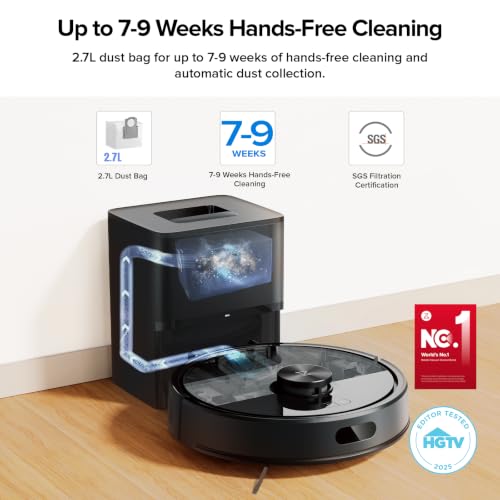
The two configurations share the same robot. The Q7 M5 comes with a charging base about the size of a hardcover book standing on its spine. That base charges the robot and nothing else, so you empty the onboard bin by hand. The Q7 M5+ adds the RockDock Plus, which pulls debris into a sealed 2.7-liter bag. Roborock claims 7 to 9 weeks per bag, and pets and frequent scheduling will shorten that. Neither dock touches the mop.
The robot is a 12.8-inch disc, about 3.9 inches tall. A LiDAR turret on top (a spinning laser that measures distances) builds the floor plan, which is why it cleans in tidy rows and why the app shows labeled rooms. Underneath are a rubber comb-style main brush, an anti-tangle side brush, and a combined dustbin and 270 ml water tank feeding a detachable cloth. Roborock calls it a vacuum-mop hybrid. In practice it's a vacuum that drags a damp cloth, and it's priced accordingly.
Why a basic Roborock beats busier budget robots
Start with the 10,000 Pa suction claim, because it tells you the least. Pascal ratings aren't measured consistently from brand to brand, and suction alone doesn't lift dirt. Brush contact, airflow to the bin, and whether the robot actually drives over every patch of floor matter more. A rival with a bigger number and sloppy routing will leave strips untouched and clean one corner twice. The Q7 covers each room once, in order, then goes home.
The app is the second advantage. Roborock's software has matured across a long lineup, and the Q7 gets the full set: room and zone cleaning, schedules, no-go and no-mop zones, suction and water controls, map editing, and multi-floor maps. You can run the kitchen after dinner, fence off the dog bowl, and keep the cloth off the rug without opening the app every day.
That lineup also keeps brushes, filters, and dock bags easy to find, and off-brand robots often fade once their consumables do. We think predictable mapping, mature software, available parts, and honest pickup reinforce one another, which is why we rank the Q7 above cheaper robots with longer feature lists. Evaluators also describe the robot as relatively quiet. The Plus dock is not. Its emptying cycle is loud but over in seconds.
How the Q7 M5 handles real floors
Both configurations use the same robot: LiDAR navigation, a rubber comb-style main brush, a 3,200 mAh battery, and a static mop pad. The dock decides how often you handle dust. It has no effect on how well the robot cleans. Here's how that robot handles each kind of job.
| Workload | Outlook | What to expect |
|---|---|---|
| Hard floors and everyday crumbs | Excellent | This is the Q7's strongest surface. Sand, cereal, and kitchen grit come up cleanly, and because LiDAR plans methodical passes instead of random bouncing, a tile kitchen or laminate hallway ends a scheduled run looking freshly swept. Expect a little debris to remain at baseboards and in tight corners. |
| Low- and high-pile carpet debris | Solid for the class | It clears most visible debris from both carpet heights. Pulling out ground-in grit is a different job, and on that one it's merely average. A rug that gets frequent runs stays well kept. Neglected carpet still needs a real vacuum occasionally. |
| Pet hair | Respectable, better than the price suggests | Fur on carpet mostly comes up in one pass, which our old review undersold. The catch is volume. The bin holds less than its rating in practice, so a shedding dog fills it fast. That makes the strongest argument for the Plus dock. |
| Long human hair | Expect brush cleanup | The anti-tangle brush helps with short fur. Long strands are a separate problem, and they still wrap around the roller. Homes with long hair should plan on regular brush cleanup with either model. |
| Light mopping | Bonus only | A damp, static pad handles fresh footprints and fine dust. It doesn't scrub, it can leave floors wet, and neither dock washes, refills, or dries it. Lift it off or set no-mop zones around rugs. |
| Cluttered floors, cords, pet accidents | Poor | With no camera or obstacle-recognition sensor, it can't tell a charging cable from a floorboard seam. Clear the floor before a run. If you can't count on a clear floor, buy a robot that can see. |
| Larger homes on one charge | Good | Runtime is generous at moderate suction, and when a job outlasts the battery the robot recharges and picks up where it stopped. In a big house, the bin fills up long before the battery runs out. |
The Q7's carpet reputation rests on two results that seem to disagree. Both are accurate. Vacuum Wars' standardized embedded-dirt test put its carpet deep cleaning at 75 percent, exactly its category average. In its lab evaluation, RTINGS found the robot clears most everyday debris from low- and high-pile carpet and called its hard-floor pickup excellent. Those tests answer different questions: how much grit comes out from deep in the pile, and whether the visible mess is gone after a normal run. Owners see the second result every day, and the Q7 handles it well.
Pet hair follows the same pattern. On Vacuum Wars' pressed-in fur test, the Q7 collected 79 percent against an 81 percent average, which is effectively a tie. Tom's Guide measured 80 percent on tile and 70 percent on carpet with its own method. Those numbers come from different methods and shouldn't be averaged, but they point the same way: this is a capable fur vacuum for the money. Our earlier verdict that carpet and pet hair were weak spots doesn't hold up.
Suction is not what limits this robot. Perception is. The Q7 always knows where it is in your home, but it has no idea what's in front of it. On a floor cleared before the run, it cleans like a far pricier machine. How much you pick up beforehand decides which of those you get.



While you're comparing
The right product, at a better price
Our free morning email rounds up discounts worth knowing about, from kitchen upgrades to everyday tech. Reviews and buying guides arrive separately in our occasional newsletter.
Free to joinUnsubscribe anytime
Living with it: bins, brushes, and a damp cloth
The bin shapes your routine more than anything else. Roborock lists it at 400 ml, but one exact-model evaluation found pickup slipping at around 300 ml. In a one-bedroom with hard floors, that's plenty, and emptying it becomes a ten-second habit. With a shedding retriever in a larger home, it can fill before the run ends, and a full bin keeps driving while it mostly pushes hair around.
Long hair is a separate chore, and no dock fixes it. Pet fur generally reaches the bin. Long human strands are different: two exact-model evaluations found that they still wrapped around the brush even when fur usually reached the bin. In a house with several long-haired people, plan on clearing the roller every week or two.
The mop handles fresh footprints and fine kitchen dust on the lowest water setting. Pull it for carpet runs or draw no-mop zones around rugs, then wash the cloth yourself. Battery life rarely gets in the way: one exact-model evaluation measured about 75 minutes on max power and around 160 on the lowest, and the robot recharges and resumes when a large floor needs it. Brushes, filter, wheels, and sensors need regular care on both versions. The robot connects over 2.4 GHz Wi-Fi, which nearly every modern dual-band router still provides.
It maps the room, but it can't see what's on the floor
LiDAR tells the Q7 where walls and furniture are, not that a phone cable is lying across the hall. Across exact-model evaluations, cords, rug tassels, clutter, and simulated pet waste produced the usual budget-robot rescues. In homes with toddlers' toys, desk cables, or a pet prone to accidents, the failures go well past a missed spot. That's a job for a pricier robot that can see. The same missing lens does mean nothing on the robot is photographing your home.
At roughly 3.9 inches tall it needs about 4 inches of clearance, and taller thresholds and some dark rugs can stall it. Check that charcoal runner before you commit.
The mop data shows how one score can mislead. One standardized test scored dried stains at 158 against a 93 average, yet measured 2.0 grams of water left behind versus 1.01. A separate exact-model evaluation found the pad ineffective on dried stains and noted damp floors. Our read is that the extra water softens stains enough to lift one controlled score while leaving streaks and slow-drying floors. Treat the mop as a bonus, not a reason to buy.
Q7 M5 or Q7 M5+: Is the self-emptying dock worth it?
Ask how often the bin will fill mid-run. A small apartment, a short-haired cat, or a carpeted bedroom rarely fills it. A heavy-shedding dog or a large single-level home fills it often, and because a full bin stops cleaning well, the Plus dock improves results there as well as saving you a chore. It also suits anyone who wants several runs a week while away from home.
The base charger, at 160 by 70 by 101 mm, tucks behind a door. The Plus station, at 212 by 178 by 259 mm, is closer to a small trash can and needs open wall space. For a second floor, guest suite, or weekend-only robot, the small base and lower price win. Apply our price-gap rule from the verdict: once the premium climbs well past it, obstacle recognition is the better use of that money.
Is the Q7 M5 enough for carpet and a shedding pet?
For most carpeted pet homes, yes, as a maintenance cleaner. It collects visible fur, tracked-in grit, and crumbs from low- and high-pile carpet, but it's only average at pulling out embedded dirt, so an upright or occasional professional cleaning still has a place. Frequent runs play to its strengths: removing surface fur three or four times a week keeps hair from being ground deep into the pile, and the Plus dock is what makes that schedule effortless.
Two things change the answer. Long human hair adds brush cleanup no matter how well the robot handles fur. A pet that has accidents is a firm stop, because the Q7 can't detect them and no setting changes that. If either applies, choose a robot that can see.
Who this product fits
One-bedroom apartment, hardwood and a small rug
Buy the base Q7 M5. Bare floors are its strongest surface, the slim charger disappears behind a door, and emptying a bin after a small apartment run takes seconds. Draw a no-mop zone around the rug, clip on the damp pad when footprints build up, and keep the difference in price for something that actually needs it.
Three bedrooms with a shedding dog
Get the Q7 M5+. This robot handles fur on carpet well. What it can't handle is the volume, because the bin fills quickly and pickup drops before it's full. The dock solves that. Schedule three or four runs a week, keep chew toys off the floor, and plan on swapping bags sooner than Roborock suggests.
Upstairs bedrooms with a better robot downstairs
The base model makes a sensible second robot. Bedrooms usually stay tidy, the floor area is small, and the compact charger doesn't take over a hallway. Because the area is limited, the bin rarely becomes a nuisance, and a Plus dock upstairs would mostly be paying to save a chore you'd barely notice.
Toddler, toys, and cables behind the TV
Skip this family. A robot that can't recognize a stray block or a charging cable will spend its runs getting stuck and waiting for you to free it, which defeats the point of scheduling it. In this home, extra money for obstacle recognition goes straight toward cleanings that actually finish.
What else to compare
Moving up from the Q7 family makes sense for two reasons: a robot that can see what's on the floor, or a dock that takes care of the mop as well as the dust. If either matters in your home, the higher picks in our robot vacuum guide are where to look.

Roborock Q7 M5 / Q7 M5+ FAQ
What's the difference between the Roborock Q7 M5 and Q7 M5+?
Only the dock. Both use the same robot. The Q7 M5's base just charges it, so you empty the bin by hand. The Q7 M5+ adds the RockDock Plus, which empties dust into a sealed 2.7-liter bag. Neither dock does anything with the mop.
Is the Roborock Q7 M5 good for pet hair?
Yes, and better than its price suggests. It clears most fur from carpet in one pass and lands close to category norms in standardized testing. The bigger limit in a pet home is bin capacity, which is why we point pet owners to the Plus.
Does the Q7 M5 avoid cords, socks, and pet waste?
No. Its LiDAR builds the map but can't identify objects, and the robot has no camera. Pick up the floor before it runs, and don't use it where a pet accident could be waiting.
Can the Roborock Q7 M5 mop well?
It handles light upkeep, not real mopping. The static cloth picks up fresh footprints and fine dust, but it won't break down dried spills and can leave floors damp. Consider it a bonus that comes with a good vacuum.
Does 10,000 Pa suction mean it cleans better than other robots?
Not by itself. Brands don't measure suction the same way, so the number doesn't compare cleanly across models. The Q7 earns its place through measured pickup, which comes from brush design, airflow, and orderly routes.
How long does the battery last?
Long enough for most homes in one go, with the actual time depending on suction level. If a large floor plan runs it down mid-clean, it heads back to charge and then finishes the job on its own.
Will long hair tangle in the brush?
Some will. The comb-style roller handles pet fur well, but long human strands still wrap at a slightly above-average rate. In a long-haired household, plan on cutting the roller free every week or two on either model.
Q7 M5 or Q7 M5+: which one should you get?
Both get you a capable, dependable vacuum with mapping you can trust. The real choice is how much you want to deal with the dustbin.
If your home is small and you don't mind a quick empty after runs, get the plain Q7 M5 and keep the savings. If you have shedding pets or a lot of floor to cover, get the Q7 M5+, provided it costs roughly $100 more and not a lot more. If your floors are rarely clear, neither version is the right buy, and the extra money for a robot that can see obstacles is well spent.