Explore Robot Vacuums for more buying guides, in-depth reviews, comparisons, and practical advice.
Ten current picks for different homes and budgets, led by the no-compromise Dreame X60 and the value-focused Ecovacs T90S Pro Omni.
By Pickori Research Desk
Daily Deals
Start every morning with deals worth a look
Pickori Daily Deals is one free email each morning with discounts we think are worth sharing. Enjoying this guide? Add our occasional newsletter for more reviews, guides and tips too.
Free to joinUnsubscribe anytime
Published Updated
If you buy through links on this page, Pickori may earn a commission.
Start with your floors
Buy for your mess, not the spec sheet
A self-emptying dock and a mop pad sound great until you realize your real problem is shedding dog hair on wool rugs. Each pick below says plainly who it suits and where it falls short.
This is the robot to buy when you do not want to choose between carpet cleaning, hard-floor pickup, mopping, clutter avoidance, and reaching beneath low furniture. Other flagships beat it in isolated categories; none gives up less across an entire mixed-floor home.
Watch for: The dock is large, and its routes are thorough rather than quick.
Choose the Flow when clean tile, wood, or vinyl matters more than winning every carpet test. Its roller keeps washing itself as it works, while Roborock's mature app and composed navigation make the machine unusually easy to trust.
Watch for: Small onboard containers make it unusually dependent on its dock.
Most round robots leave a faint border of crumbs along walls and beneath cabinet overhangs. The V70's unusually long mop and side-brush reach attack those neglected strips while still delivering the cleaning performance expected from a premium machine.
Watch for: The software is less proven, and heavy pet hair can challenge the bagless bin.
This is where the list becomes interesting: a continually rinsed roller mop, a dock that cleans its own tray, and strong everyday pickup at roughly half the flagship list price. Most homes will notice what it keeps and barely miss what it gives up.
Watch for: Embedded carpet grit and small-object avoidance are not flagship-level.
The S2 earns its place in homes where socks, cables, toys, and pet bowls are part of the floor plan. Its unusually convincing obstacle avoidance is backed by strong carpet cleaning, tangle resistance, and a roller mop that stays fresh while it works.
Watch for: It carries flagship pricing and can still stumble at some carpet transitions.
The E35 keeps the expensive Eufy experience where it matters: strong cleaning, quiet operation, a continuously refreshed roller mop, and credible clutter avoidance. It is the smarter starting point when the S2's extra refinement sounds appealing but its price does not.
Watch for: There is no dedicated mop-only mode, and its maps can develop minor quirks.
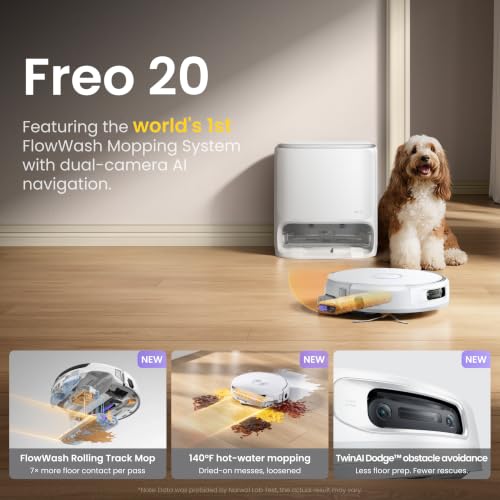
The Freo 20 is for the home that wants spotless hard floors without hearing the robot announce itself from the next room. Its continuously rinsed track-style mop resists streaks and hair tangles while keeping the whole routine unusually quiet.
Watch for: Carpet pickup and recognition of small floor clutter are weaker.
A carpeted home with shedding pets needs pickup and brush design more than a glamorous mop. The L60 backs that priority with excellent deep-cleaning and pet-hair results, plus a brush that resisted long-hair wrap in standardized testing.
Watch for: Mopping is ordinary for the price, and tall transitions are not its specialty.
The C28 is proof that stepping down in price no longer means accepting weak cleaning and a decorative mop. It combines genuinely strong debris pickup with capable carpet work, anti-tangle hardware, and a roller mop maintained by a full-service dock.
Watch for: Navigation and obstacle recognition are less sophisticated than the leaders.
The budget win is knowing which flagship features not to imitate badly. The Q7 M5 concentrates on dependable mapping and solid vacuuming; choose the self-emptying M5+ if pet hair would fill the small onboard bin too quickly.
Watch for: The static mop is useful for a light wipe, not serious scrubbing.
Buy the Dreame X60 Max Ultra Complete if you want the fewest compromises and can live with a large dock. Choose the Roborock Saros 20 Flow instead if a mature app and calm, composed navigation matter more to you than the last bit of under-furniture reach. Its self-cleaning roller mop fixes the one real weakness of the original Saros 20, though its tiny onboard dust and water containers leave it leaning on the dock more than most. The MOVA V70 Ultra Complete is the pick for homes with lots of cabinet overhangs and wall edges, provided you accept less proven software.
For most people, though, the Ecovacs Deebot T90S Pro Omni is the machine to look at first. At its $899.99 manufacturer list price, it brings a continuously rinsed roller mop, a dock that washes the roller and its own tray, and modern carpet protection for roughly half the list price of the top flagships. Exact-model testing supports the central value case: daily debris pickup and mopping are strong, while embedded carpet grit, clutter avoidance, and route efficiency remain the reasons to spend more. If you want Eufy's strengths without paying for the Omni S2, the Omni E35 is the sensible middle ground. The lower-priced Eufy Omni C28 delivers a full-service dock without the weak cleaning that used to come with it. At the budget end, the Roborock Q7 M5 is a good vacuum first and a very basic mop second. Buy it on those terms and you will be happy.
Most robot vacuums rarely fail at vacuuming. They fail at the phone charger under the couch, the dog's water bowl, the rug edge they keep climbing and abandoning, and the dirty mop they drag from the kitchen into the living room. A robot that eats a cord once is a robot you stop trusting, and a robot you stop trusting goes back in the closet.
That is the lens for this ranking. The best robot vacuum of 2026 is the Dreame X60 Max Ultra Complete, because it is the most complete package available in the US: excellent carpet and hard-floor pickup, strong mopping, obstacle avoidance that clears 22 of 24 standard hazards, a low body that reaches under furniture, and a dock that handles nearly everything. It is expensive and bulky, and its onboard bin is small. None of that changes the conclusion.
The more interesting decisions happen below the top spot. Spending around $1,700 buys refinement, not a different category of clean. Around $1,300, you can choose a specialist for edges or a sensible premium all-rounder that skips the flagship flourishes. At about $900, a new flagship-grade roller mop and hot-water dock are within reach. Around $500, full-service docks with genuinely good cleaning are now normal. Under $300, the right move is a reliable vacuum, not a cheap imitation of a flagship. The ten machines below are ranked in order, and each entry explains who should skip a higher pick and buy it instead.
How we ranked these robots
The order starts with what a robot actually does on your floor: debris pickup on hard floors and carpet, pet hair, resistance to long hair wrapping around the brush, and whether the mop cleans or simply redistributes dirty water. Then come the qualities that decide whether you keep running it: navigation, obstacle avoidance, the ability to climb thresholds and rug edges, app reliability, and how much upkeep the dock quietly hands back to you. We weighed standardized independent measurements heavily, especially where more than one rigorous evaluation agreed, and gave extra caution to machines whose strengths rest on a single source, on early owner reports, or, in the case of the newest models, mainly on confirmed hardware.
Price matters, but as a question of value rather than a tiebreaker. A $1,300 machine has to justify itself against a $900 one with a similar roller mop and hot-water dock, which is exactly why the T90S Pro sits above more expensive robots, and why the E35 lands just below the Omni S2: it keeps most of what matters day to day while giving up the flagship's more advanced vision and more elaborate floor care. Some strong machines missed the list for specific reasons. The original Saros 20 and the Ecovacs T80S Omni remain capable current products, but the Saros 20 Flow and T90S Pro now represent their brands more convincingly. Roborock's Qrevo Edge 3 Pro is too new to have enough independent testing behind it, the Dyson 360 Vis Nav still lacks auto-emptying, mopping, and object recognition, and no current Roomba combines cleaning, navigation, and value well enough to compete with this field.
Three things the spec sheet will not tell you
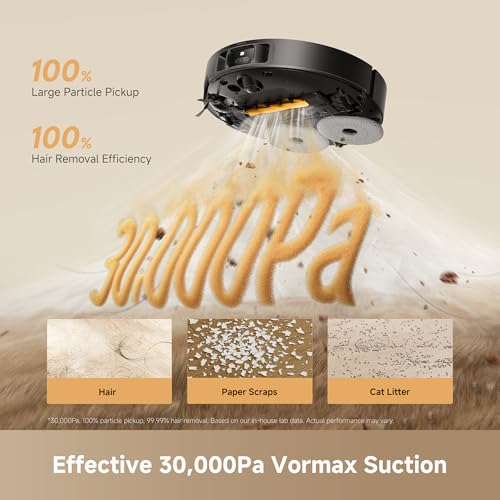
Ignore the suction number on the box, or at least stop comparing it across brands. Pascals (Pa) measure pressure difference, and each manufacturer measures it in its own way, at its own point in the airflow, under its own conditions. There is no shared test standard, so the T90S Pro's 40,000 Pa claim is not proven to clean better than the E35's 35,000 Pa or the Saros 20 Flow's 36,000 Pa. Actual pickup depends just as much on brush design, how well the robot seals against carpet, and how thoroughly it covers the room. That is why this guide leans on measured results such as carpet deep-clean percentages and pet-hair pickup, not claimed suction.
Mop design matters more than most buyers expect. The long-standing premium approach uses two spinning pads, which scrub reasonably well but carry the same pad through the whole cleaning run until the robot returns to rinse it, so later rooms get a progressively dirtier pad. That was the clearest weakness of the original Saros 20, and it is the main reason the Saros 20 Flow replaces it here. A roller mop, found on the Saros 20 Flow, T90S Pro, Omni S2, Omni E35, and Omni C28, is a spinning cylinder that is continuously rinsed and squeegeed while the robot moves, so the surface touching your floor stays fresh. Rollers still differ: the T90S Pro adds heavy downward pressure, while the E35 oddly offers no dedicated mop-only mode. Narwal's track-style mop on the Freo 20 chases the same fresh-surface idea. At the bottom of the market, a static pad (like the Q7 M5's) simply drags a damp cloth behind the robot. It freshens a floor; it does not really scrub it.
Finally, treat the dock as half the product. A full-service dock empties the bin, washes the mop, and refills clean water, but it also becomes the thing you maintain: dirty-water tanks to empty and rinse, wash trays to wipe, dust bags to buy, or bagless bins that can clog when pet hair piles up. It also takes up real floor space, which matters with the larger flagship docks. Some robots lean on their docks harder than others: the Saros 20 Flow's small onboard containers mean it returns to base more often, so the dock's reliability matters even more. A robot that cleans brilliantly but needs its dock tended every few days is not truly hands-off, so the upkeep a dock creates counts in these rankings as much as the features it advertises.
Still deciding?
Good finds, delivered fresh every morning
While you weigh your options, let our free daily email bring a handful of worthwhile discounts to your inbox. Our occasional newsletter, with new reviews and buying guides, is a bonus extra.
The most complete robot cleaner on the US market right now. It vacuums carpet and hard floors at the top of the field, dodges clutter reliably, and asks the least of you between cleanings.
Suction claim
35,000 Pa (manufacturer claim)
Mop system
Dual Omni-Scrub pads, 15 N pressure, 230 RPM
Dock
Auto-empty, 212 F mop wash, hot-air dry, water and solution refill
The X60 Max Ultra Complete earns the top spot because it has the fewest weak categories of any robot we considered. That matters more than any single headline result. A robot vacuum is only as useful as the worst room in your house, and the X60 handles carpet, hard floors, pet hair, clutter, and thresholds all at a high level. Independent standardized testing recorded near-perfect carpet pickup and complete hard-floor pickup. Separate lab work found excellent carpet deep cleaning, perfect flattened pet-hair pickup, and 22 of 24 obstacles avoided. Those are the numbers of a machine you can run daily without trailing behind it.
A note on the 35,000 Pa suction figure printed on the box, because Dreame, like every brand, leads with it. Pascal ratings measure pressure under conditions each manufacturer chooses for itself. There is no shared test standard, so one brand's number and another's are not measured the same way, and none of them account for brush design, airflow path, or how well the robot seals against carpet. That caveat applies to every figure in this guide, including the 36,000 Pa Roborock and the 40,000 Pa Ecovacs below. The X60 ranks first because of how much dirt it actually removes in testing, not because of its Pa figure.
The dock deserves as much scrutiny as the robot, and this is where the X60's price starts to make sense. A full-service dock empties the bin, washes and dries the mop, and refills water, and every one of those jobs creates a small chore of its own: dust bags to replace, a dirty-water tank to dump, a wash tray that eventually needs scrubbing. A dock that does its job well turns a weekly battle into an occasional check-in. The X60's dock is thorough, and that thoroughness is why the robot's small onboard bin, a real weakness on paper, rarely bothers owners in practice. The dock empties it before it becomes a problem.
The compromises are real, though. The X60 still mops with spinning pads, while the Saros 20 Flow directly below it has moved to a continuously washed roller, so buyers whose main concern is spotless tile have a genuine argument for the Roborock. The dock is bulky, so plan a spot for it before you order. Navigation efficiency is merely average, which means the X60 is thorough rather than quick. And it shares the top manufacturer list-price tier with the Flow at $1,699.99. Retail prices move constantly, and this one is frequently discounted below list, which is when it becomes the easiest flagship recommendation to make. At full price you are paying for strength everywhere rather than excellence in one area.
Best for
Mixed-floor homes with carpet, hard floors, and pets where no single weakness is acceptable
Owners who want the most hands-off routine a robot can currently deliver
Look elsewhere if
Hard-floor mopping matters more to you than carpet and clutter, which points to the roller-mopping Roborock Saros 20 Flow
Your budget stops near $900, where the Ecovacs Deebot T90S Pro Omni brings flagship-style hardware for far less
Pickori's decision
Buy it if you want one robot that handles everything well and you can live with a big dock. Try to catch it below list; at a discount it is the clearest premium purchase in the category.
Closest comparison: The Roborock Saros 20 Flow costs the same at list and mops better with its self-cleaning roller, but the X60 is the more complete package across carpet, obstacle avoidance, and low-furniture reach.
Roborock's composed navigation and mature app, now paired with a roller mop that keeps washing itself. It is the premium robot to pick if clean hard floors come first, provided you accept its dependence on the dock.
Suction claim
36,000 Pa (manufacturer claim)
Mop system
SpiraFlow 2.0 continuously self-cleaning roller
Dock
212 F (100 C) mop wash with full-service dock
Threshold handling
Two-stage system rated for combined transitions up to 8.8 cm
Roborock's case has always rested on how easy its robots are to live with. The app is mature, maps stay dependable, and the robot moves through a house with the settled confidence of software refined over many generations. The original Saros 20 had all of that, and its clearest weakness was the mop: two spinning pads that kept pressing the same cloth into the floor until the next trip to the dock. The Saros 20 Flow is the answer to that weakness, and it is why the Flow, not its sibling, holds this spot. Treat it as a different floor-care design rather than a trim level. The original Saros 20 remains a usable current robot; it has simply been overtaken here by a better one.
The change is the SpiraFlow 2.0 roller. Instead of two round pads, the Flow rolls a cylinder that is washed continuously while it works, so a fresh surface keeps meeting the floor rather than a cloth growing grimier across the kitchen. The practical difference is what you do not see afterward: the faint streaks and redistributed film spinning pads can leave in the last rooms of a run. In direct testing, the Flow produced excellent, stripe-free mopping, which is exactly the result the design promises. Back at the dock, the roller gets a 212 F wash to deal with the grease and residue that cold water leaves behind.
The vacuuming and avoidance are strong enough that the mop is not doing all the work. The Flow picked up 99.6 of 100 grams in a debris test, avoided cables, socks, shoes, and simulated pet waste, and finished without brush tangles. Edges are good rather than perfect: it collected 17 of 20 peas placed along walls, so a few stray crumbs at the baseboard are realistic, and the MOVA V70 is the better tool if edges are your particular headache. The two-stage threshold system, rated for combined transitions up to 8.8 cm, carries Roborock's reputation for climbing over raised doorways and thick rug edges into the new model. Run time in testing was roughly four hours, which covers large homes in a single pass.
The trade-off is unusual, and worth understanding before you buy. The Flow's onboard dust bin and water tank are small, which means it leans on its dock more heavily than most flagships. In normal use the dock empties and refills it, so you will rarely notice. But the robot is not a machine to pick up and carry to a distant room for a long spot clean, and a dock placed far from where the mess happens costs efficiency. That dependence, along with the X60's broader strength across carpet, avoidance, and under-furniture reach, is why the Flow ranks second. At the same $1,699.99 manufacturer list price as the Dreame, the choice between them comes down to whether your floors are mostly hard or mostly mixed.
Best for
Homes dominated by tile, wood, or vinyl where streak-free mopping is the priority
Buyers who value dependable app behavior and composed navigation, especially with tall thresholds
Look elsewhere if
You want a robot that works well away from its dock, given its small onboard bin and water tank
Carpet, clutter, and low furniture define your home, where the Dreame X60 Max Ultra Complete is the more complete machine
Pickori's decision
Buy the Saros 20 Flow if hard floors are the center of your home and you want Roborock's calm, reliable behavior with a mop that finally matches it. Choose the Dreame instead if carpet and clutter weigh as heavily as tile.
Closest comparison: Against the Dreame X60, the Flow mops cleaner and climbs thresholds with Roborock's usual composure, but gives up some all-round strength and depends more heavily on its dock at the same price.
The robot that reaches the corners and cabinet toe-kicks other round machines leave behind, with a bagless dock that ends the dust-bag habit. The software still has growing up to do.
Suction claim
42,000 Pa on the US model (manufacturer claim)
Mop system
Dual 300 RPM pads, 15 N pressure, 17 cm extension
Dock
Bagless auto-empty, mop wash and dry, water and solution refill
Round robots have a geometry problem. They cannot reach into a corner, and they struggle along walls and under the overhang of kitchen cabinets, which happens to be exactly where crumbs and dust collect. The V70 addresses this with an unusually long mop and side-brush reach that pushes cleaning out past the body. If you have ever run a robot and then knelt down with a hand vacuum to finish the baseboards, this is the machine aimed at you.
It is not a one-trick purchase, either. Independent testing supports excellent debris pickup, strong mopping, reliable obstacle avoidance, and unusually capable threshold crossing. In other words, the edge reach comes attached to a robot that already competes near the top on fundamentals. At $1,299, it undercuts both the Dreame and the Saros 20 Flow by $400 while matching them in more categories than the price suggests. Its mop is still a pair of spinning pads rather than a roller, so it will not match the Flow's streak-free finish on large stretches of tile, but it gets those pads into places a roller robot's body never reaches.
The bagless dock is the other attraction, and it deserves careful thought. Dust bags are a recurring cost and a recurring errand. A bagless dock replaces them with a bin you empty yourself, which is cheaper over time but not maintenance-free. Early owner reports describe that bin clogging under heavy pet hair. For a household with one short-haired cat, that is a minor note. For a house with two shedding dogs, a clogged dock means a robot that stops emptying and fills its own bin mid-run, and that undoes much of what you paid a dock to do.
Software is the main reason the V70 sits third rather than higher. Its app and dock are less proven than Roborock's, and some early owners report app instability. That does not make it a bad bet, but it does make it a younger one. You are trading some confidence in long-term polish for better edge cleaning and a lower price. Not a dealbreaker, just something to go in knowing.
Best for
Kitchens and rooms with long cabinet runs, tight corners, and lots of wall edge
Owners who want to stop buying dust bags and are comfortable emptying a bin
Look elsewhere if
You have heavy-shedding pets, given reports of the bagless bin clogging
You want the most proven app and the cleanest roller mopping, which points to the Roborock Saros 20 Flow
Pickori's decision
Buy the V70 if edge and corner cleaning is the thing current robots keep failing at in your home. It is excellent value at $1,299 for households without a lot of pet hair.
Closest comparison: Against the Saros 20 Flow, the V70 is $400 cheaper and reaches edges better; the Flow counters with steadier software, a self-cleaning roller mop, and a longer reliability record.
The T90S Pro Omni is the robot most shoppers should look at before paying flagship money. At its $899.99 manufacturer list price, it costs $400 less than the MOVA and $800 less than the Dreame or Saros 20 Flow at their listed prices, yet it keeps the hardware that changes everyday ownership: a continuously rinsed roller mop, a dock that washes the roller and rinses its own tray, carpet protection, and automatic dust emptying. This is not a bargain because the spec sheet is loud. It is a bargain because the expensive parts are the useful parts.
The mop is where that value becomes visible. Like the Saros 20 Flow and Eufy Omni S2, the T90S rolls a cylinder that is rinsed as it works, so a cleaner surface keeps meeting the floor instead of the same two pads carrying kitchen grime into the next room. The OZMO Roller 3.0 runs at 220 RPM with a manufacturer-rated 4,000 Pa of downward pressure. The numbers alone do not prove cleaning quality, but exact-model evaluations found convincing stain removal and clean-looking hard floors. A 15 mm lift and physical cover protect ordinary rugs, while the U.S. dock washes the roller at up to 167 F and rinses its own tray.
Vacuuming is strong where most households need it. One evaluation recovered 92 percent of oats from tile and 90 percent from carpet, while a tougher sand test landed at 75 percent. That combination explains the T90S better than its 40,000 Pa suction claim: it is excellent for visible crumbs, pet debris, and routine mixed-floor cleaning, but only average at pulling embedded grit from carpet. The flagship premium starts making sense when deep carpet, rather than hard-floor care, is the main job.
Navigation and clutter handling keep it in fourth. Exact-model reports found useful obstacle avoidance but inconsistent results with cords, socks, and furniture legs, and the robot can take longer routes than the more composed leaders above it. Its 2.5 cm threshold rating also trails the Saros 20 Flow's much more ambitious climbing system. In a reasonably tidy home with ordinary doorways, those limits may never justify another $400 to $800. In a cluttered home with tall transitions or lots of deep carpet, they are precisely what the extra money buys.
Best for
Hard-floor homes, including pet households, that want roller mopping and hot-water mop care without flagship pricing
Buyers who would rather keep several hundred dollars than pay for the most refined app
Look elsewhere if
You want a robot with a long, broadly measured track record, where the Dreame X60 or Saros 20 Flow are safer bets
You need to climb tall thresholds, where the Saros 20 Flow's 8.8 cm system is far more capable
Pickori's decision
For most hard-floor and ordinary mixed-floor homes, the T90S Pro Omni is the rational stopping point. Its roller mop and self-cleaning dock deliver most of the flagship experience; deeper carpet, chronic clutter, and difficult thresholds are the reasons to keep spending.
Closest comparison: The Eufy Omni S2 shares the roller-mop approach and has a proven, near-perfect avoidance record, but it costs hundreds more for that confirmed caution.
The most careful robot here around cords, toys, and pet messes, now with the carpet cleaning its predecessor lacked. You pay a premium for that caution.
Suction claim
30,000 Pa (manufacturer claim)
Mop system
HydroJet roller, 1.5 kg pressure, 240 RPM
Dock
Full-service Omni dock with mop care and dust emptying
Some homes are simply hard on robots. A toddler's building blocks, a phone charger trailing off the couch, a dog that occasionally has an accident. In those homes, one wrong turn costs more than a missed patch of floor: a cable wrapped around a brush, or a mess spread across a rug. The Omni S2 is the robot to buy when that risk is the deciding factor. Independent testing recorded perfect obstacle avoidance, and that is the whole case for putting it on this list.
It also corrects the weakness that held back the original Omni S1. That model mopped nicely but disappointed on carpet. The S2 posted an 87 percent carpet deep-clean result, better-than-average flattened pet-hair pickup, and zero long-hair tangles. Those are not the best carpet numbers in the group, but they are good enough that you no longer have to choose between a careful robot and a capable vacuum. The continuously washed roller mop carries over, keeping hard floors clean without the dirty-pad drag of spinning systems.
Two things keep it fifth. The first is price. At a $1,599.99 manufacturer list price, it costs more than the MOVA V70 and $700 more than the T90S Pro Omni at their listed prices, even though the Ecovacs also uses a roller mop and a newer generation of 3D obstacle avoidance. The S2's advantage is that its avoidance has been proven in testing, while the T90S has not yet built the same record. The second is that longer-term testing has exposed occasional carpet-transition errors, where the robot stumbles moving between rug and hard floor. That is the kind of issue that rarely shows up in a single test run and matters over months of use.
So the question is how much the remaining obstacle risk costs you. If a single swallowed cord or smeared pet mess would ruin your week, the extra money buys peace of mind with a measured record behind it. If your floors are usually clear, it is a lot to pay for a feature you seldom need. And if you like the Eufy approach but not the flagship price, the Omni E35 keeps the continuously refreshed roller and convincing avoidance for $1,299.99, giving up some of the S2's more advanced vision and floor-care system.
Best for
Homes with kids' toys, loose cables, or pets that occasionally leave messes
Owners who want roller-mop hard floors with dependable carpet performance
Look elsewhere if
Your floors are usually tidy, which makes the T90S Pro Omni the smarter spend
Your home has many rug-to-floor transitions, given reported transition errors
Pickori's decision
Buy the S2 if clutter is your biggest robot problem and the current retailer price makes sense against the T90S Pro Omni. Otherwise, the Ecovacs brings roller mopping and modern avoidance for far less at list price.
Closest comparison: Against the T90S Pro Omni, the S2 costs much more but backs its caution with a proven avoidance record; against the Dreame X60, it gives up broader cleaning strength for similar money.
The E35 delivers most of what makes Eufy's flagship S2 worth buying: a self-cleaning roller mop, persuasive obstacle avoidance, and strong cleaning on every floor, for less money. It is still a premium purchase, not a bargain.
Suction claim
35,000 Pa (manufacturer claim)
Mop system
HydroJet 2.0 roller mop, continuously refreshed during cleaning
The E35 is the Eufy most people should look at before they look at the S2. It keeps the part of Eufy's approach that makes the biggest daily difference, a roller mop that is rinsed with clean water as it works, and pairs it with navigation and object avoidance good enough that you do not have to clear the floor like you are preparing for an inspection. What it leaves out are the S2's more advanced vision and its more elaborate floor-care system. Those are real upgrades, but they are refinements on top of a cleaning package the E35 already gets mostly right.
The independent evidence supports that reading. Reviewers found excellent suction, mopping, navigation, and self-cleaning, which is a notable combination because most robots at this level are clearly stronger at one job than the other. In obstacle testing, the E35 steered around a sock, simulated pet waste, and a coiled cable. Those three items are the ones that actually ruin a robot run: a sock jams the brush, a cable wraps around it, and pet waste turns a convenience into a cleanup disaster. A robot that reliably sees all three is one you can start while you are out of the house with some confidence.
Several of the smaller hardware choices point at chores rather than headlines. The DuoSpiral brush system is designed to shed hair instead of winding it up, the CornerRover extension reaches toward edges that round robots tend to miss, and the dock washes the mop with hot water and dries it with heat, which is what keeps a roller from turning musty between runs. The E35 is also unusually quiet in operation, a genuine advantage if you run it while working from home or in the evening.
Here's the thing worth knowing before you buy: there is no dedicated mop-only mode. For most robots that would be a footnote. For one whose roller mop is among its main attractions, it is a strange omission, and it matters if you want to run a quick mopping pass on a kitchen without the robot vacuuming the whole route again. Reviewers also saw some minor phantom-room behavior in mapping, where the map shows spaces that are not really separate rooms. Neither problem is a dealbreaker, just something to tidy up in the app or plan around.
The E35 ranks sixth because it sits in a sensible middle position. It costs more than the Ecovacs T90S Pro, which lists at $899.99 and brings a roller mop and very strong hardware claims, but the E35 has the more established independent record for navigation and avoidance. It costs less than the S2 and gives up the flagship flourishes. Against the Narwal Freo 20 just below it, the E35 is the more balanced cleaner for homes with rugs and everyday clutter. At $1,299.99 list, it is not a value pick, but it is a well-judged one.
Best for
Mixed-floor homes that want strong vacuuming and a self-cleaning roller mop in one robot
Pet owners and busy households who need dependable avoidance of socks, cables, and pet messes
People who run the robot while home and appreciate quiet operation
Look elsewhere if
You want the most advanced Eufy vision and floor care, where the Eufy Omni S2 is the flagship
You often want to mop without vacuuming, since the E35 has no dedicated mop-only mode
You want the strongest hardware for the money and accept a thinner independent test record, where the Ecovacs Deebot T90S Pro Omni costs less
Pickori's decision
Buy the E35 if you want a genuinely capable all-rounder that handles clutter and mops well without paying for every flagship extra. It is the sensible premium Eufy. Step up to the S2 only if its more advanced vision and floor care justify the extra spending for your home.
Closest comparison: Against the Eufy Omni S2, the E35 gives up advanced vision and the more elaborate floor-care system but keeps the continuously washed roller and convincing obstacle avoidance. Against the Narwal Freo 20, it is the better choice for rugs and clutter, while the Narwal stays the more mop-focused machine.
The Freo 20 is for homes where clean hard floors matter more than deep carpet cleaning. It mops beautifully and quietly, but it asks you to accept a weaker vacuum on rugs.
Suction claim
31,000 Pa (manufacturer claim)
Mop system
FlowWash track mop, 12 N pressure, rinsed with water up to 140 F
Dock
Auto-empty, hot-water mop wash, hot-air dry, and water management
Most robot mops fail in the same quiet way: they start clean, pick up grime in the kitchen, then spread a thin film of it through the hallway. The Freo 20 is built around avoiding that problem. Narwal's track-style mop is rinsed continuously while it works, so the surface touching your floor keeps getting refreshed instead of carrying one room's dirt into the next. The result is hard floors that look clean afterward, without the streaks that undermine many spinning-pad robots.
That design matters because it brings Narwal's mopping approach below the price of the Flow 2. Here's the model distinction worth knowing: the Flow 2 and the Freo 20 are different products. Mopping reputation and test results for one should not be assumed for the other. The Freo 20 is the cheaper entry into the same general philosophy, and it keeps several of the traits that make Narwal pleasant to live with. It runs quietly and resists hair tangles, which cuts down on one of the least pleasant chores of robot ownership: cutting wrapped hair off a brush roll.
The trade-off is specific, and it explains why this robot sits at seventh rather than higher. Independent home testing found weaker carpet cleaning than the Eufy Omni S2 delivers, occasional scattering of coarse debris such as spilled grounds or litter, and less reliable recognition of small obstacles. None of those is a disaster alone. Together, they describe a robot that prefers a tidy, mostly hard-floored home. If your floor regularly holds charging cables, small toys, or a scatter of kibble, the Freo 20 is more likely to need your help than the S2 or the Eufy Omni E35, both of which handle everyday clutter with more confidence.
On value, the Freo 20 makes the most sense for a particular buyer rather than as a general bargain. At $1,099.99 MSRP it costs more than the Ecovacs Deebot T90S Pro Omni's $899.99 price, and the Ecovacs is built as the more complete vacuum. It sits about $200 below the E35, which is the better all-rounder. What the Freo 20 offers in return is a quieter, mop-first personality. If you live with tile, sealed wood, or laminate throughout and you notice every footprint, that priority is legitimate, and the Freo 20 serves it well.
Best for
Homes that are mostly hard floor where visible mopping quality is the top priority
Owners who run the robot while home and value quiet operation
Look elsewhere if
You have a lot of carpet or thick area rugs, where the Dreame L60 Ultra PE is the stronger choice
Your floors are regularly cluttered with cords, socks, or small pet messes, where the Eufy Omni E35 is the safer pick
Pickori's decision
Buy the Freo 20 if you mostly care about hard floors looking properly clean and your home stays reasonably tidy. It is the most convincing mop-first choice in this part of the list. If carpet or clutter matters, spend a little more on the Eufy Omni E35, or less on the Ecovacs Deebot T90S Pro Omni.
Closest comparison: Against the Eufy Omni E35, the Freo 20 gives up carpet strength and obstacle recognition for a mop-first focus and a lower price. Against the Dreame L60 Ultra PE, it reverses priorities: the Narwal mops better, the Dreame vacuums carpet far better.
This is the pick for the reader who looked at the flagships and thought, I just need it to get the carpet clean. The L60 Ultra PE posted a 94 percent carpet deep-clean score in independent testing, which is the headline number here and the reason the robot earns its place. Carpet deep cleaning measures how much embedded debris a robot pulls out of the pile, not just what sits on top. It is the hardest test for a robot vacuum, and 94 percent is a result that competes with machines costing far more.
The supporting evidence points the same way. It achieved perfect pickup of flattened pet hair, the kind that gets pressed into carpet fibers and resists a quick pass. It also showed no long-hair wrap on the brush. For homes with shedding dogs or cats, or a household member with long hair, those two results matter more in daily life than almost any dock feature. A robot that tangles means regular brush cleanup. A robot that does not tangle simply keeps working. Obstacle avoidance came in at 21 of 24, which is respectable. It is not as sharp as the Eufy Omni S2 or E35, but it is sound enough that ordinary household clutter should not derail most runs.
The compromises are real and worth planning around. The L60 Ultra PE gives up some of the Dreame X60's threshold climbing, so tall transitions between rooms deserve a look before you buy. It also lacks some of the X60's premium dock refinements. The bigger trade-off is mopping, which is ordinary for a robot at this price. It uses spinning pads, so it will freshen hard floors, but it will not match the continuously rinsed mops on the Narwal Freo 20, the Eufy Omni E35, or even the far cheaper Eufy Omni C28.
That weakness is exactly why it ranks eighth and not higher. As a do-everything robot, it is uneven. As a carpet-and-pet machine, it is one of the clearest buys on the list. Its $1,099.99 manufacturer list price undercuts the X60 by a wide margin while keeping much of what makes that robot good on carpet. If most of your floor space is soft and the dog is the main source of mess, that is a sensible trade.
Best for
Carpeted homes and homes with thick area rugs
Households with shedding pets or long hair that tangles cheaper brushes
Look elsewhere if
Mopping quality matters as much as vacuuming, where the Eufy Omni E35 or Ecovacs Deebot T90S Pro Omni are more complete
You have tall thresholds, where the Dreame X60's climbing ability earns its higher price
Pickori's decision
For carpeted homes with pets, the L60 Ultra PE is the value play among Dreame's lineup: flagship-class carpet cleaning without flagship pricing. Treat the mop as a bonus rather than a reason to buy, and it will be easy to live with.
Closest comparison: The Eufy Omni C28 is usually much cheaper and has the better mop design, but the L60 Ultra PE pulls ahead on carpet depth and obstacle handling. Choose the Dreame for carpet and pets, the Eufy for a balanced clean on a tighter budget.
The C28 is the least expensive way into genuine hands-off robot ownership that still cleans properly. It trades obstacle intelligence for price, and the trade is fair.
Suction claim
15,000 Pa (manufacturer claim)
Mop system
HydroJet roller, 1 kg pressure, 270 RPM
Dock
5-in-1 station: empty, refill, wash, dry, and collect wastewater
The C28 is where full-service robot ownership stops being a luxury purchase. Its dock handles the routine work that makes a robot feel hands-off, and it pairs that dock with cleaning that is better than its place in Eufy's lineup suggests. Independent testing found at least 90 percent pickup in nearly every standardized debris test, along with strong carpet cleaning and good anti-tangle performance. That consistency is the point. Cheaper docked robots often look fine in one test and collapse in another. The C28 stays competent across the board.
The mop is a genuine highlight at this level. Like the Eufy Omni S2 and Omni E35 higher up the list, the C28 uses a continuously washed roller mop rather than a pair of spinning pads. That matters for the same reason it matters on premium machines: the surface touching your floor is refreshed as the robot works, so it is less likely to smear grime from one room into the next. Getting that design in Eufy's least expensive Omni model is the strongest argument for this robot.
Here's the honest trade-off. The C28 lacks the obstacle intelligence and premium navigation of the machines above it. In a tidy home, you may never notice. In a home with loose cables, pet toys, or the occasional sock on the bedroom floor, you will need to pick up before each run, or accept that the robot will sometimes get stuck or push things around. For pet owners worried about an accident on the floor, the E35 is the sensible step up and the S2 is the flagship, because avoidance is exactly what the extra money pays for.
Value is what keeps the C28 on this list. It is Eufy's least expensive route to a full-service dock and continuously washed roller mop, and discounts can make it especially compelling. That makes it a smart first robot for someone who wants mopping, emptying, and mop care handled without hovering over a flagship budget. The reasonable expectation is a very good everyday cleaner, not a clutter-dodging genius.
Best for
First-time buyers who want a full-service dock without flagship pricing
Tidy homes with mixed floors that want a proper roller mop
Look elsewhere if
Your floors are often cluttered, where the Eufy Omni E35's obstacle avoidance is worth the premium
Your home is mostly carpet with shedding pets, where the Dreame L60 Ultra PE digs deeper
Pickori's decision
Buy the C28 when its current retailer price clearly undercuts the E35. You get a roller mop, a full-service dock, and consistently strong pickup, but at its $799.99 manufacturer list price it faces tougher competition. It rewards owners willing to do a quick floor sweep of cords before pressing start.
Closest comparison: The C28, E35, and S2 share Eufy's roller-mop approach. Each step up buys better obstacle avoidance and more refined features, so the right choice depends on how messy your floors really are and how much you want to pick up before a run.
Every robot above this one has a washing dock, a clever mop, or some form of obstacle intelligence. The Q7 M5 has none of that, and it still belongs in the top ten. The reason is simple: it does the basic job well. It maps your home reliably, cleans both hard floors and carpet well for its class, and delivers a sturdier, more coherent ownership experience than many anonymous ultra-budget robots. It is not a placeholder budget slot. A robot that vacuums properly and knows where it is beats a robot with a longer feature list that wanders.
Reliable mapping is what separates it from cheaper options. A good map lets you send the robot to one room, set no-go zones around a pet bowl, and trust it to cover the house rather than bump around randomly. That matters more to daily satisfaction than most features further up the price ladder. Roborock's app maturity is part of the appeal, too: the same brand behind the Saros 20 Flow builds this robot, and the software shows it.
The naming needs a quick explanation. The Q7 M5 is the robot on a charging base. The Q7 M5+ is the same robot with an auto-empty dock that sucks debris out of its bin. For pet owners or larger homes, choose the M5+, because the onboard bin fills quickly and a full bin stops cleaning. The honest trade-off is the mop. It is a static pad dragged behind the robot, it cannot lift over carpet, and it provides little more than a light wipe. That makes this fundamentally a vacuum recommendation. If you want real mopping, look to the Eufy Omni C28.
At its $299.99 manufacturer list price, the Q7 M5 gives budget buyers what they should prioritize: pickup, navigation, and a platform that behaves predictably. Spending more buys automation and mopping, not a fundamentally cleaner carpet in an ordinary home. For a small apartment, a mostly carpeted bedroom floor, or a second robot upstairs, that is often the smartest money on the list.
Best for
Budget buyers who want dependable vacuuming and mapping
Pet owners and larger homes, specifically with the M5+ auto-empty dock
Look elsewhere if
You want meaningful mopping, which this static pad cannot provide
Your floors are cluttered, since it lacks the obstacle intelligence of the pricier picks
Pickori's decision
Buy the Q7 M5+ if you have pets or more than a few rooms, and the plain Q7 M5 if you live small and do not mind emptying the bin. Either way, buy it as a vacuum. It does that job well enough to belong beside machines that cost several times more.
Closest comparison: The Eufy Omni C28 is the step up when you want a full-service dock and a real mop. The Q7 M5 is the better choice when price is the priority and vacuuming is the job.
How to choose the right robot vacuum for your home
Start with your floors, not the suction number
Your floor mix decides more than any headline spec. Mostly carpet points you toward proven carpet performers such as the Dreame L60 Ultra PE, which posted a 94 percent deep-clean result. Mostly tile, laminate, or sealed wood lets you prioritize mopping, which is where the Narwal Freo 20 shines. Mixed floors reward balanced machines like the Eufy Omni E35, the Ecovacs Deebot T90S Pro Omni, or the flagships at the top of the list.
Ignore pascal suction numbers when comparing brands. A pascal (Pa) figure describes pressure measured under the manufacturer's own conditions, and brands do not measure it the same way. It also ignores brush design, airflow, sealing, and how the robot moves over carpet. The T90S Pro's 40,000 Pa claim does not automatically beat a 30,000 Pa machine, and a 36,000 Pa Saros 20 Flow is not automatically weaker. Independent carpet and debris results are the numbers worth trusting whenever they exist.
Pets and clutter: tangles and obstacle avoidance
If you live with shedding pets or long hair, look for anti-tangle results first. Hair wrapped around a brush roll is the most common chore robot owners end up doing by hand. The Dreame L60 Ultra PE and Eufy Omni C28 both showed strong tangle resistance in testing, the Narwal Freo 20 resists wrapping as well, and the Eufy Omni E35 is built around an anti-tangle brush system. Flattened pet-hair pickup is the most useful measure of how well a robot handles fur pressed into carpet.
Clutter is a separate question. Obstacle avoidance tells you how likely a robot is to swallow a cable, push a toy across the room, or hit something worse. If your floor is rarely clear, spend for proven avoiders such as the Eufy Omni S2, the Eufy Omni E35, or the Roborock Saros 20 Flow, all of which steered around the classic hazards of socks, cables, and simulated pet waste. If you are happy to pick up before each run, cheaper robots like the C28 or Q7 M5 become far more attractive.
Set realistic mopping expectations
Robot mops come in three broad types. A static pad drags behind the robot and gives a light wipe, useful for dust but not for dried spills. Spinning pads rotate against the floor and scrub harder, but they reuse the same fabric until the robot returns to the dock, which can spread dirty water between rooms. Roller and track-style mops clean their surface during the run, so the fabric touching your floor stays fresher.
That is why the roller and track designs on the Roborock Saros 20 Flow, Ecovacs T90S Pro, Eufy E35, Narwal Freo 20, and Eufy C28 matter, and why the technology now reaches well below the flagship tier. None replaces a proper scrub of a sticky kitchen floor, but they keep hard floors noticeably cleaner between deep cleans. One detail to check: the E35 lacks a dedicated mop-only mode, which matters if you like quick mopping passes. If mopping is a minor bonus for you, a strong vacuum like the Dreame L60 Ultra PE or Roborock Q7 M5 is the more sensible purchase.
Maintenance tolerance: the dock is part of the robot
A full-service dock empties the bin, washes the mop, and refills water, but it does not make the robot maintenance-free. You still refill clean water, empty dirty water, clean trays where grime collects, and replace bags or clear bagless bins. A dock that clogs or smells simply moves the chore from your floor to the dock, so reliability belongs in the buying decision alongside cleaning results. Some robots lean on the dock harder than others: the Saros 20 Flow's small onboard dust and water containers make it unusually dependent on frequent dock visits.
Be honest about how much of this you want to do. If you want the least hands-on routine, a full-service dock such as those on the E35 or C28 is worth paying for, and hot-water washing with heated drying helps keep mops from souring. If you would rather keep things simple, a basic auto-empty dock like the Q7 M5+ handles the most frequent chore at a far lower price. Keep in mind that street prices move often in this category, so a robot one rank lower can become the better buy during a sale.
Questions answered
Robot vacuum FAQ
Is a higher Pa suction rating always better?
No. Pa figures are manufacturer claims measured in different ways, and they ignore brush design, airflow, and navigation. Independent carpet deep-clean and debris-pickup results are far more reliable ways to compare robots.
Should I buy the Eufy Omni E35 or the Eufy Omni S2?
The E35 is the better fit for a straightforward mixed-floor home with carpet, pets, long hair, and a busy kitchen. The S2 costs more but has the stronger clutter record and better transition hardware for a difficult floor plan.
Is the Ecovacs T90S Pro just a renamed T90 Pro?
No. The T90S Pro raises the suction claim to 40,000 Pa and revises the roller system, adds a wet-roller cover, and gives the dock its own tray-rinsing cycle. Exact-model testing supports its strong daily cleaning and mopping, while carpet grit, clutter avoidance, and route efficiency remain more ordinary.
Do I need a self-emptying dock?
If you have pets or a larger home, yes. Small onboard bins fill quickly, and a full bin stops cleaning. That is why we recommend the Roborock Q7 M5+ over the plain Q7 M5 for those households.
Are roller mops really better than spinning pads?
For avoiding dirty streaks, generally yes. Roller and track-style mops clean their surface as they work, while spinning pads reuse the same fabric until the robot returns to the dock. Spinning pads still scrub well, but they are more likely to carry grime between rooms.
Can a budget robot vacuum handle carpet well?
A good one can. The Roborock Q7 M5 cleans carpet well for its class and maps reliably. What budget robots give up is mopping quality, obstacle avoidance, and dock automation, not basic vacuuming.
Will a robot vacuum replace my regular vacuum?
For daily upkeep, often yes. Most homes still benefit from an occasional manual clean of stairs, upholstery, and tight corners, and even the best docks need regular emptying and rinsing.
Pickori's final word
The right robot is the one whose weakness never touches your home. A mop-first machine is excellent until it meets deep carpet, and a carpet specialist is excellent until you expect spotless tile. Match the robot to your floors, your clutter, and the chores you are willing to keep, then buy the best cleaner you can afford within that fit. For many mixed-floor homes, that fit now lands on a self-cleaning roller mop paired with real obstacle avoidance, which is why the Eufy Omni E35 opens this half of the list.
If you are still torn, prioritize measured cleaning results and reliable navigation over dock features and suction claims. A robot that cleans well and knows where it is will earn its place every single day. One that only looks impressive on paper will not.
Before you go
Make your morning inbox a little more useful
Join Daily Deals for one free, easy-to-skim email of discounts every morning. Want more guides like this? Add our occasional newsletter too for fresh reviews and handy tips.