

Pickori's Take
- Buy the MOVA V70 Ultra Complete for awkward floor plans, cabinet overhangs, deep edges, and tall transitions. It is the best premium robot for those difficult spaces, particularly near its roughly $1,000 street price. The Saros 20 Flow is better for hygienic mopping across broad hard floors, and the Dreame X60 remains Pickori's more complete mixed-floor flagship.
- The reach is real. A 17 cm mop extension and 12 cm of side-brush reach let it clean under toe-kicks and radiators, and one controlled lab measured a wet edge gap of just 1 mm. No other part of the V70 is backed up as consistently.
- Ignore the 42,000 Pa badge. Pickup of everyday debris and hair is excellent, and rugs fared well in home use, but one lab measured only 72.9 percent fine-dust pickup at maximum power. Suction claims aren't standardized across brands.
- The pads scrub hard at 300 RPM and 15 N and clear ordinary dried stains, but they can't carry dirty water away mid-clean the way a rinsed roller can. Greasy spills may need a second pass.
- Bagless saves money, not effort. Hair and lint collect at the dock's lid and prefilter, and emptying the bin releases dust, so allergy households should favor sealed bags. At $1,299, buy selectively. At around $1,000, it's a strong flagship pick for complicated homes.
Round robots have a geometry problem
A 350 mm circle can't put its brush into a square corner. It also can't slide its mop under a cabinet toe-kick it's too tall to enter. Most robots accept this and leave a crescent of crumbs along every baseboard. The V70 pushes its cleaning hardware outward instead.
MOVA quotes 17 cm of mop reach and 12 cm of side-brush reach, and the way each is measured matters. The mop figure is the distance the center of the pad travels from its resting position to its extended position. The brush figure runs from the robot's body to the brush's outer edge. That outward travel is how the V70 gets under radiators and overhangs instead of stopping at their front edge.
This review covers the black US Complete package. The transparent European V70 Ultra Complete X is functionally similar but may ship with different cleaning solutions and accessories. The V70 Ultra without the Complete name is a separate package, so check the exact listing before you buy.
How the MOVA V70 Ultra Complete handles a real home
The V70's results sort neatly by geometry. Where a job involves an edge, an overhang, a chair leg, or a raised lip, it tends to beat ordinary round robots. Where the job is raw extraction or long-run mop hygiene, it's merely good.
| Workload | Outlook | What to expect |
|---|---|---|
| Hard-floor debris | Excellent for everyday crumbs and spills | Visible debris is where the V70 looks most like a flagship. In one apartment test it picked up oats, buckwheat, coffee grounds, and hair almost completely from hard floors, which covers most of what a kitchen and dining area produce in a week. The dual TroboWave rollers and long side brush matter more here than the suction badge because they sweep debris out of edges and into the intake. This is the job you'll stop thinking about first. |
| Carpet and fine grit | Good on rugs, middling on deep fine dust | The evidence splits here. Longer home use found above-average results on low-pile and coarse rugs. One controlled lab, however, measured just 47.4 percent fine-dust pickup at minimum power and 72.9 percent at maximum, and it rated raw suction slightly below average. Fine salt also needed a second carpet pass in another test. Different debris and protocols explain the gap. They also show why the 42,000 Pa claim predicts little, and MOVA's own US page lists 40,000 Pa elsewhere. If grit is your main problem, schedule extra passes. |
| Dried stains and greasy spills | Strong scrubbing, limited dirty-water removal | The two pads spin at up to 300 RPM with up to 15 N of downward pressure, and ordinary dried coffee and food stains usually cleared. Greasy mayonnaise and the most stubborn marks sometimes needed a second pass. The deeper limit is the process itself. Pressure loosens grime, but a spinning pad holds that dissolved dirt until the dock rinses it. A roller that is washed while it cleans lifts dirty water into a separate tank instead of carrying some of it into the next room. |
| Long hair and pet fur | Credible for shedding pets | The anti-tangle dual roller mostly lives up to its design. Independent testing found no hair wrapped on the main or side brush in one evaluation and only occasional strands around the central roller in another. That's far better than the scissors routine older brush rolls demand. MOVA's hair claims remain manufacturer claims, but the independent pattern is favorable. The bigger pet-hair chore moves to the bagless dock, where hair and lint gather at the lid and prefilter and have to be cleared by hand. |
| Corners and cabinet toe-kicks | Its best reason to exist | A round robot usually leaves a crescent of grime in every corner and a dusty strip under every cabinet overhang. The V70 extends its mop 17 cm (measured from the pad's center to its extended center) and its side brush 12 cm beyond the body. Multiple direct tests found it reaching under radiators, low furniture, and toe-kicks, and between chair legs. One controlled lab measured a wet edge gap of just 1 mm. For kitchens with long cabinet runs, this row is the whole argument. |
| Clutter and small obstacles | Strong, but not a license to skip tidying | Retractable LiDAR, an RGB camera, structured light, and LED illumination give the V70 a clear view of the floor. Independent runs generally avoided pet waste, cables, glassware, Lego, keys, and tissues, which covers what most owners worry about. Still, one sock and one rope dog toy caused failures in separate protocols. The 300-object and 99.9 percent pet-waste figures are MOVA's own claims. Treat avoidance as insurance, and pick up soft, stringy items before a run. |
| Thresholds and low furniture | Built for old door tracks | MOVA rates the StepMaster chassis to climb about 4.5 cm in a single step, or 9 cm across a compatible two-stage transition. That 9 cm figure is not one vertical wall. Independent tests cleared roughly 3 cm easily, and one lab recorded 5 cm capability. With the LiDAR retracted, the robot drops to about 88 to 89.5 mm, which is low enough for many sofa and cabinet gaps. Split thresholds and raised tracks are exactly where this hardware pays off. |
| Large and complicated floor plans | Capable, with some map supervision | Stamina isn't the constraint. In longer home use it cleaned 50 square meters in 86 minutes with battery to spare, and it resumes after recharging. One home got about three full mopping sessions from the dock's 4.0 liter clean tank. Software is the weaker spot. Mapping is fast, but tests found an aborted first run, a misnamed room, skipped zones, clumsy floor-boundary editing, and hesitant routing. Plan to check and correct the first maps. |
The pattern is consistent enough to trust. The V70 wins wherever shape defeats a conventional robot, and it is good rather than exceptional wherever the task is pure extraction. That's why its marketing leans on the wrong number.
The weaknesses can all be managed. Fine grit may need another carpet pass, greasy spills may need a second mop, and the app wants some supervision. None of these is as fundamental as a round robot's inability to reach a toe-kick at all.
That makes your floor plan the deciding factor. A home full of cabinets, chairs, radiators, and raised tracks uses nearly every part of this machine. A flat, open apartment pays for engineering it will rarely touch.


42,000 Pa is not the result
The US specification table claims 42,000 Pa, while another section of the same page still says 40,000 Pa. Neither number carries across brands, because manufacturers don't measure suction the same way. The badge says nothing about what ends up in the bin.
What ends up in the bin depends on the debris. In one apartment test, oats, buckwheat, coffee grounds, and hair on hard floors disappeared almost completely, and low-pile and coarse rugs scored above average. A controlled lab using fine dust was less flattering. It measured 47.4 percent pickup at minimum power and 72.9 percent at maximum, and it rated raw suction slightly below average. In a separate test, fine salt needed a second pass on carpet.
Both results can be true. Visible debris rewards brush design and routing, while grit embedded in a rug rewards sustained airflow. Pickori's read is that the V70 is excellent for crumbs, litter, and hair and ordinary for sand ground into carpet. The TroboWave DuoBrush earns its anti-tangle claim. Hair stayed off the rollers entirely in one test and showed up only occasionally around the central roller in another.
Powerful pads still carry dirty water
The pads are the V70's strongest cleaning tool, and reach is the reason. One controlled lab measured a wet edge gap of about 1 mm and rated mopping and corner cleaning highly. Direct tests watched the pads work beneath radiators, cabinet overhangs, and low furniture. At up to 300 RPM and 15 N of pressure, they clear ordinary dried coffee and food stains, though greasy mayonnaise and the hardest marks sometimes took a second pass.
Pressure is not the same as extraction. A spinning pad loosens grime and absorbs it into the fabric, where it rides along until the next wash at the dock. A roller mop is rinsed continuously and sends dirty water to a separate tank while it cleans. Across a large, heavily soiled floor, pads can spread dissolved grime further than a roller would.
On rugs, the V70 can lift its mop 10.5 mm, avoid carpet entirely, or remove the pads automatically. For thick pile, choose removal. Carpet detection was generally reliable in independent testing.
Bagless means cheaper upkeep, not no upkeep
The dock does real work. MOVA claims pad washing at up to 100 C and drying at up to 70 C. One direct test measured wash temperatures above 100 C and drying around 61 C, and heavily soiled pads came out dry and ready to use. The 4.0 L clean and 3.5 L dirty tanks lasted about three full mopping sessions in one home, though the number will vary with floor area and water setting.
Bagless is the economic argument: a washable 2.0 L bin replaces proprietary dust bags for good. That doesn't make the dock maintenance-free. Hair and lint collected around the lid and prefilter in testing. The manual also calls for monthly care of the auto-empty vent, a new HEPA filter every six months, and dust-tank cleaning every two to four months.
Emptying the bin also puts you close to a load of fine dust, so households with severe allergies should prefer a sealed bag. Pet homes should expect more frequent bin and prefilter cleaning. The dock measures 420 x 458 x 470 mm, so plan its spot before it arrives.
Where the flagship hardware earns its space
Thresholds are where the climbing chassis justifies itself, and the numbers need care. MOVA rates a single step at about 4.5 cm. The 9 cm figure applies only to a compatible two-stage transition, not one vertical wall. Independent tests cleared roughly 3 cm easily, and one lab recorded 5 cm of climbing capability. Old door tracks and split thresholds are the kind of obstacle it's built for.
Low furniture benefits too. With the LiDAR retracted, the robot stands 88 to 89.5 mm tall, which lets it get under more sofas and cabinets than a robot with a fixed sensor turret.
Large homes are covered by the 6,400 mAh battery and the robot's ability to recharge and resume. One home test cleaned 50 square meters in 86 minutes with reserve left over, against MOVA's claim of up to 220 minutes. Cleaning measured under 50 dB(A) at one meter, but emptying briefly topped 70 dB(A). Keep the dock away from bedrooms if you schedule runs at night.
MOVA V70 Ultra Complete or Roborock Saros 20 Flow?
Choose the Saros 20 Flow if most of your home is broad, open hard floor and mopping is the main job. Its continuously rinsed roller keeps lifting dirty water away as it cleans. Across a long kitchen and living room, that does more for hygiene than reaching a little further under a cabinet. Roborock's app also plans and routes with steadier logic.
Choose the V70 if your floor is broken up by toe-kicks, radiator gaps, clusters of chair legs, and tall door tracks. In those homes, its 1 mm edge gap and climbing chassis address the dirt you can actually see. Roller extraction matters less when the open floor is only a small share of the job.
MOVA V70 Ultra Complete or Dreame X60 Max Ultra Complete?
The Dreame X60 remains Pickori's more complete mixed-floor flagship. It's the better fit for a buyer who wants carpet, hard floor, software, and dock behavior all consistently strong, with the fewest compromises anywhere in the house.
The V70 wins on price and awkward geometry. At around $1,000, it delivers the reach, climbing, bagless dock, and three-year warranty that matter most in complicated rooms. In exchange, you accept middling fine-dust results and rougher routing. If your rugs hold fine grit and you want the safest all-round pick, spend on the X60. If crumbs in corners bother you more than sand in carpet, the V70 is the smarter purchase.
V70 or a cheaper MOVA?
A cheaper MOVA makes sense in an open apartment with low thresholds and few overhangs. In that home, the V70's extending arm and climbing chassis would mostly sit idle, and the money saved is worth more than the extra hardware.
Before stepping down, check three things on any cheaper model: how far the mop and side brush extend, what threshold height it's rated for, and whether the dock washes and dries pads with heat. Those features are exactly what justify the V70. If a cheaper model drops them and your home has toe-kicks or tall door tracks, the V70 at around $1,000 is the better buy.
The verdict changes between $1,299 and around $1,000
At its $1,299 list price, the V70 competes with more polished, better-proven flagships, and its hesitant routing and middling fine-dust result weigh more heavily. Pay list only if your home genuinely needs its reach and climbing.
At around $1,000, the math flips. The same hardware, bagless dock, accessories, automation, and three-year warranty make it one of the strongest flagship values of 2026 for complicated rooms. The flaws haven't changed, but you're no longer paying high-end money to live with them. A flat, simple home still doesn't need it.
Who this product fits
A kitchen lined with cabinets and toe-kicks
This is the V70's home turf. Crumbs land against cabinet bases and slide under the toe-kick lip, exactly where round robots stop short. The extending mop and brush clean that recessed strip along the whole run, and hot pad washing handles daily splashes. Wipe up oily spills first, because greasy messes may still need a second pass.
A pet home with rugs and long hair
It's a strong fit. The dual rollers resist wrap, obstacle recognition generally dodged pet waste and cables, and carpet rules keep wet pads off the rugs. There are two cautions. Rope toys and socks can still trip it up, and the bagless dock becomes the main hair chore, so expect to clear fur from the lid and prefilter regularly.
An older home with tall tracks and split thresholds
Raised door tracks and stepped transitions strand many robots mid-run. The V70's climbing chassis handles most old tracks comfortably, and compatible two-stage transitions extend its range further. Spend a few minutes marking tricky thresholds and setting carpet rules room by room, because older homes rarely keep one kind of flooring from door to door.
A severe allergy household
Look elsewhere. The bagless bin saves money, but emptying it puts dust back into the air you're trying to protect, and the filters need hands-on cleaning. A dock with sealed disposable bags costs more to run. It's still the safer choice when someone in the house reacts badly to dust.
A tidy apartment with open floors
You'd be paying for reach and climbing you'll rarely use. Open floors, low thresholds, and few overhangs let a simpler robot cover the same ground, and broad hard floors favor a roller mop anyway. Put the savings toward a cheaper MOVA or a roller-mop flagship instead.
What else to compare
The V70 wins on reach and climbing, and the alternatives below win elsewhere. The Saros 20 Flow leads on continuously rinsed roller mopping and calmer software, and the Dreame X60 on mixed-floor completeness. Cheaper MOVA models win on price for homes without awkward geometry. Decide by floor shape first, then by how you want to mop, then by budget.
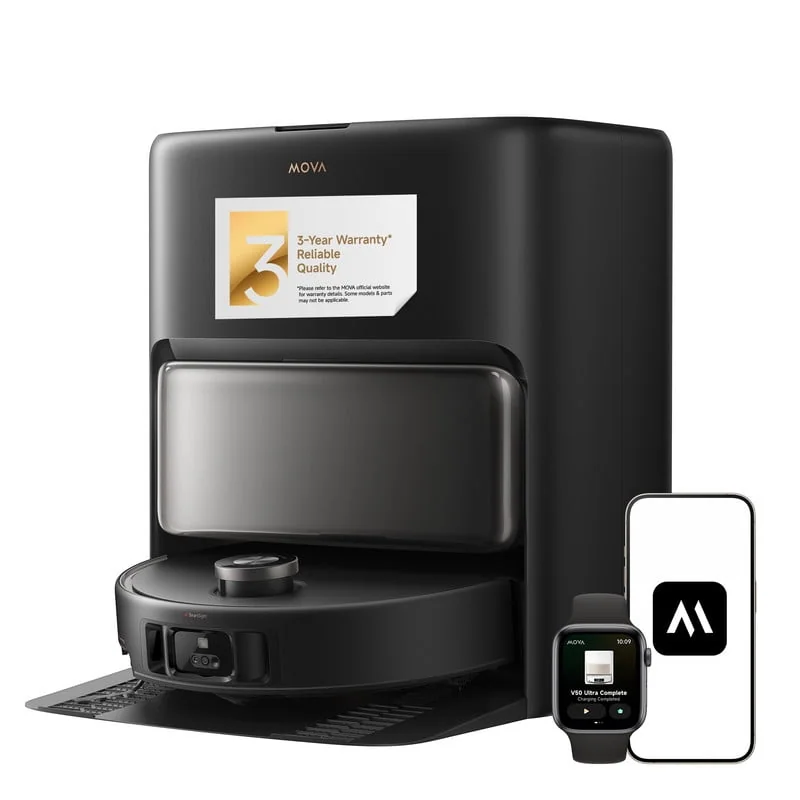 MOVA V50 Ultra CompleteThe older MOVA value alternative when carpet pickup matters more than the V70's extreme reach and bagless dock
MOVA V70 Ultra Complete FAQ
Is the MOVA V70 Ultra Complete worth it?
Yes, at around $1,000, as long as your home has cabinet overhangs, tall transitions, or crowded furniture. At its $1,299 list price, it competes with more polished flagships and only makes sense for floors that genuinely need its reach.
What is the difference between MOVA V70 Ultra Complete and V70 Ultra Complete X?
The X is a European package with a transparent finish. It's functionally similar but may ship with different cleaning solutions and accessories. The V70 Ultra without the Complete name is also a separate package, so check the box contents before you buy.
Does the MOVA V70 Ultra Complete really have 42,000 Pa suction?
That's MOVA's claim, although its US page also lists 40,000 Pa. Suction ratings aren't standardized across brands, and one controlled lab measured middling fine-dust pickup. Everyday debris pickup is excellent, but the number alone proves little.
How well does the MOVA V70 clean edges and corners?
Edges and corners are its strongest area. The mop extends beneath toe-kicks and radiators, and one controlled lab measured just a 1 mm wet gap beside an edge. Stubborn greasy marks in corners may still need a second pass.
Is the MOVA V70 Ultra Complete good for pet hair?
Yes. The anti-tangle dual rollers showed little or no wrap, and obstacle avoidance generally steered around pet waste. Rope toys and socks can still cause trouble, and you should expect regular hair cleanup at the dock's lid and prefilter.
Can the MOVA V70 Ultra Complete climb a 9 cm threshold?
Only as a compatible two-stage transition that it climbs in steps. A single vertical threshold is rated to about 4.5 cm, and outside testing recorded 5 cm of climbing capability. Measure your tallest single step, not the total height.
Does the MOVA V70 dock require dust bags?
No. The 2.0 L bin is washable and bagless, so there are no bag costs. It still needs hands-on care: hair and lint collect at the lid and prefilter, and the HEPA filter should be replaced every six months.
Should I buy the MOVA V70 or Roborock Saros 20 Flow?
Choose the V70 for cabinet overhangs, tall transitions, and furniture-heavy rooms, especially at around $1,000. Choose the Saros 20 Flow for broad hard floors, where its continuously rinsed roller keeps dissolved grime from spreading, and for Roborock's calmer app.
Should you buy the MOVA V70 Ultra Complete?
Buy the V70 if the edges of your home are the problem. Plenty of robots handle the open middle of a room competently. Very few can reach under a toe-kick, weave through chair legs, and climb an old door track in the same run, and the evidence behind the V70's reach is unusually consistent.
Buy it at around $1,000, where that reach and a full-service dock add up to a flagship bargain, and think harder at $1,299. If your floors are open and flat, or roller mopping across wide hard floors matters most, your money belongs elsewhere.
Sources and research notes
Specifications come from manufacturer documentation. Measured results are attributed to independent evaluations.
- MOVA V70 Ultra Complete US product pageMOVA
Official US identity, pricing, dimensions, core specifications, dock functions, warranty, and included accessories.
- MOVA V70 Ultra Complete testComputer Bild
Exact-model cleaning, navigation, obstacle, edge, dock, and value observations.
- MOVA V70 Ultra Complete laboratory testCHIP
Fine-dust pickup, edge gap, threshold, obstacle, noise, container-capacity, and performance measurements.
- MOVA V70 Ultra Complete reviewPC-WELT
Hard-floor and carpet behavior, hair, app, navigation, obstacle handling, mopping process, bagless-dock maintenance, runtime, and noise.
- MOVA V70 Ultra Complete testBasic Tutorials
Edge reach, stains, carpet grit, dock wash and drying temperatures, package differences, and ownership observations.
- MOVA V70 Ultra Complete reviewTom's Guide France
Mapping, obstacles, edge reach, stains, app behavior, self-maintenance, runtime, and battery observations.
- MOVA V70 Ultra Complete reviewGear Diary
Dock ownership, water-tank range, furniture-leg cleaning, mopping pressure, vacuuming, app, and buyer-fit observations.
- MOVA V70 Ultra Complete user manualMOVA
Maintenance intervals for filters, vents, dust tank, tanks, brushes, pads, and sensors.