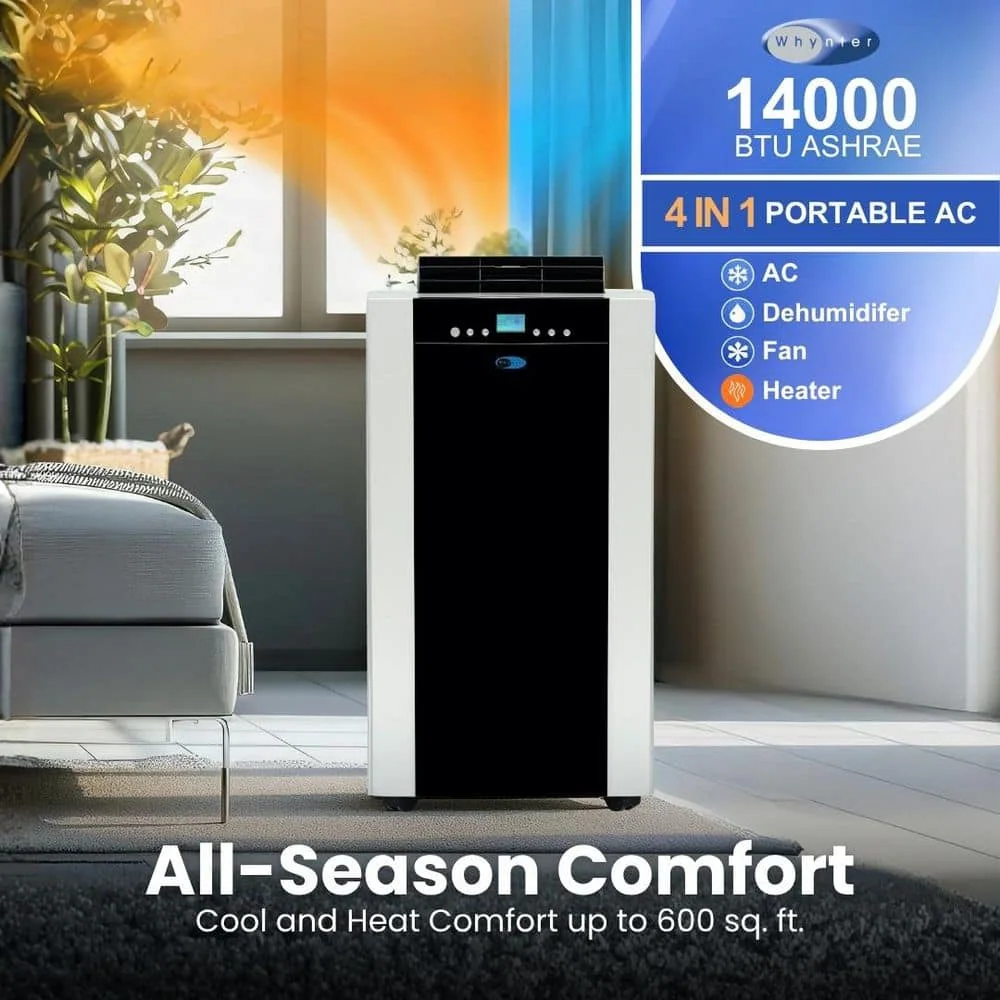
Start with watts, not BTUs
A portable AC's electricity use is measured in watts (W). Your electric bill is usually in kilowatt-hours (kWh), which is 1,000 watts used for one hour. If a unit draws 1,200 W while running, that is 1.2 kWh for each hour it is actually on. The simplest estimate is: running cost per hour equals (watts ÷ 1,000) times your electricity rate. You can find watts on the nameplate, in the manual, or by using a plug-in power meter.
Many portable ACs do not draw the same watts all the time. Fan-only mode uses less. Cooling mode uses more, especially right after startup. Inverter portable ACs (variable-speed compressor units) can ramp up and down, so their average watts can be lower than a non-inverter unit that cycles hard on and off. For cost estimates, treat the nameplate watts as a "worst case while cooling," then use duty cycle to bring the estimate back to reality.
Duty cycle is what makes or breaks the estimate
Duty cycle is the share of time the compressor is running. A unit might run nearly nonstop during a heat wave, then only 20 to 40 percent of the time on a mild day. To estimate daily cost, multiply the hourly cost by the number of hours you plan to have it available, then multiply by an estimated duty cycle. Example: if your unit costs $0.25 per hour while running and you run it for 10 hours at a 50 percent duty cycle, you spend about $1.25 that day.
What changes duty cycle is room load. Direct sun through a west-facing window, a top-floor ceiling, cooking, gaming PCs, and extra people all add heat. A portable AC also has a built-in penalty: the exhaust hose and window kit can leak hot outdoor air back in. A single-hose design can also create negative pressure, meaning it pushes air out and pulls replacement air into the home from cracks and other rooms, which can bring in more heat and humidity. Higher load means longer run time and higher cost.
Thermostat settings and comfort strategies that cut cost
Lowering the thermostat does not make a portable AC cool faster. It usually just makes it run longer. A practical approach is to pick the highest temperature that still feels comfortable, then use air movement to help. A higher fan setting can make the room feel cooler on your skin, but it can also be louder. If you sleep with the unit, try a moderate setpoint and a steady fan speed rather than chasing a very low number that forces long compressor runs.
Use the room like a system. Close doors to keep the cooled area small. Block sun with blinds or curtains during peak hours. Seal the window kit carefully so you are not paying to cool outdoor air. If the unit has an "eco" mode, understand what it does. Some eco modes cycle the fan off, which can reduce mixing and make the room feel uneven. If you have an inverter unit, a steady setpoint often saves money because it can cruise at lower power instead of repeatedly restarting at high power.
Efficiency signals that matter and marketing that does not
Portable AC efficiency is hard to compare because older headline BTU numbers can be misleading. When you compare cooling ability, use the DOE cooling capacity rating rather than older, larger-sounding numbers. For operating cost, the most useful real-world clues are: whether the unit is dual-hose (often reduces wasted cooling), whether it is inverter (often lowers average power at part load), and whether the window kit can be sealed tightly in your specific window.
Be cautious with claims like "cools a very large room" or "ultra low cost." A square-foot claim assumes average ceilings, average sun, and decent insulation. If your room is sunny, humid, or open to other spaces, the unit will run longer and cost more. Also treat "quiet sleep mode" as a tradeoff. Lower fan speed can reduce noise, but it can also reduce cooling and make the compressor run longer, which can offset savings and comfort.