
What to know first
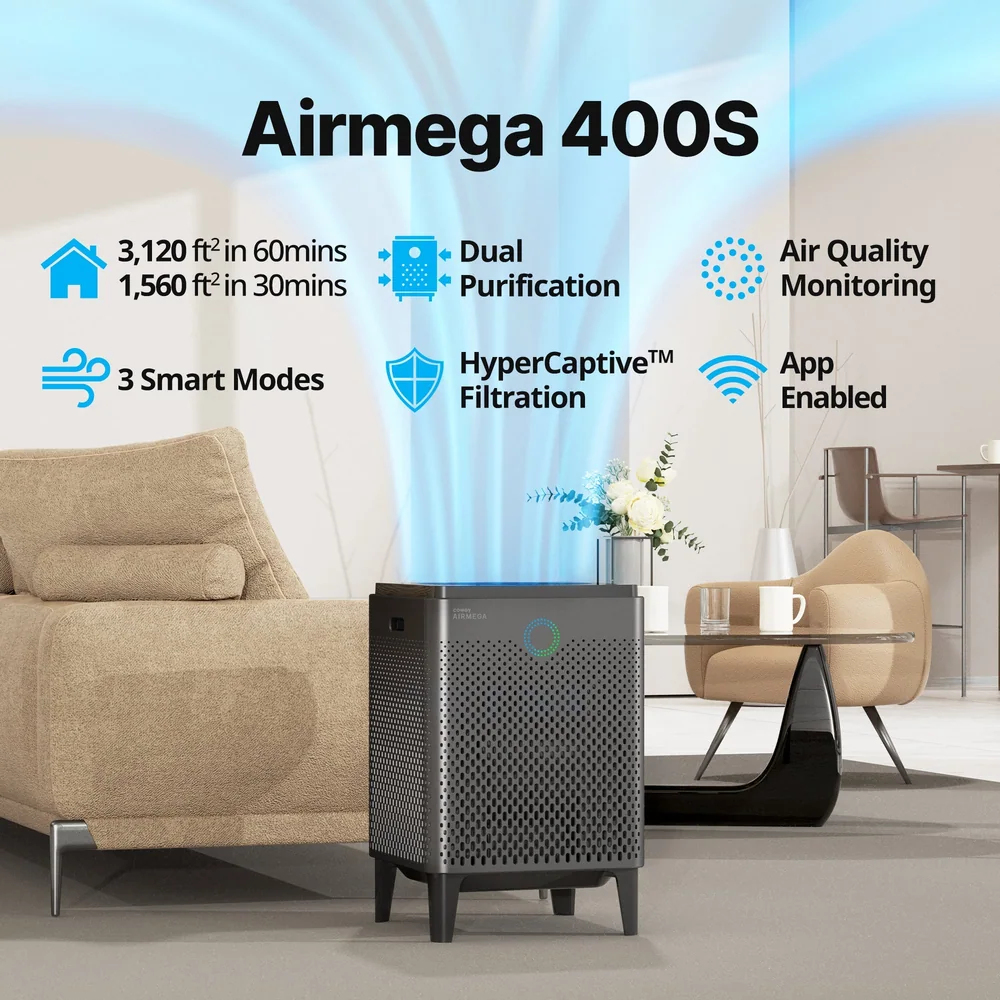
- Large-room capacity is real, but pay attention to air changes per hour: Coway lists 1 ACH at 3,120 ft² and 2 ACH at 1,560 ft².
- Strong CADR for sizing: 328 smoke, 328 dust, 400 pollen.
- Dual-filter design: two washable pre-filters plus two Max2 filters (activated carbon + HEPA).
- Smart features are the point: Wi‑Fi app control, real-time air quality monitoring, Auto, Sleep, and Eco modes.
- Noise range is listed at 22 to 52 dB(A), with a dedicated sleep behavior that drops output when the room is dark and air is already clean.
- It is a big appliance (24.7 lb), so plan where it will live before you buy.
What the Coway Airmega 400S is
The Coway Airmega 400S is a smart, high-capacity air purifier meant for large rooms and open spaces. It is designed to be the one unit you put in your main living area and let it run day after day, rather than a small purifier you move around.
Coway’s own room-size specs are unusually clear about what “coverage” means. The company lists 3,120 square feet at one air change per hour (ACH), and 1,560 square feet at two air changes per hour. In plain terms, the smaller number is the one that better matches how most people want a purifier to behave when they are trying to stay ahead of allergens or smoke.
Filtration is a dual-intake setup: it comes with two washable pre-filters and two Max2 filters. Each Max2 filter combines activated carbon (for odors and gases) with HEPA filtration (for particles like dust, pollen, and smoke-sized particles).
Why it stands out
For a large-room purifier, the Coway Airmega 400S has the kind of airflow numbers that make room sizing straightforward. Coway lists CADR at 328 for smoke, 328 for dust, and 400 for pollen. CADR is one of the most useful specs you can compare across models because it is basically a “how much clean air per minute” number for different particle types.
It is also built around automation that actually changes day-to-day use. The 400S has a particle sensor and a Smart Mode that includes Auto, Sleep, and Eco. Auto mode is the one most people will live in. You leave it alone and it adjusts fan speed based on what the sensor detects. Sleep mode is designed to kick in when the room is dark and the air quality is already good, so it can run at a very low, less noticeable level.
The “S” in 400S is about connected control. It is Wi‑Fi enabled and works with the Coway Airmega app (IoCare+), which is where you get features like a timer (1, 2, 4, or 8 hours) and a scheduler. If you like checking air quality and changing settings from your phone, this model is set up for that.
Finally, the filter system is ownership-friendly in a practical way. The pre-filters are washable, which helps keep the main filters from loading up as quickly with hair and larger dust. The unit also has a filter life indicator that calls out when to wash the pre-filters and when to replace the Max2 filters.
What it is like to own
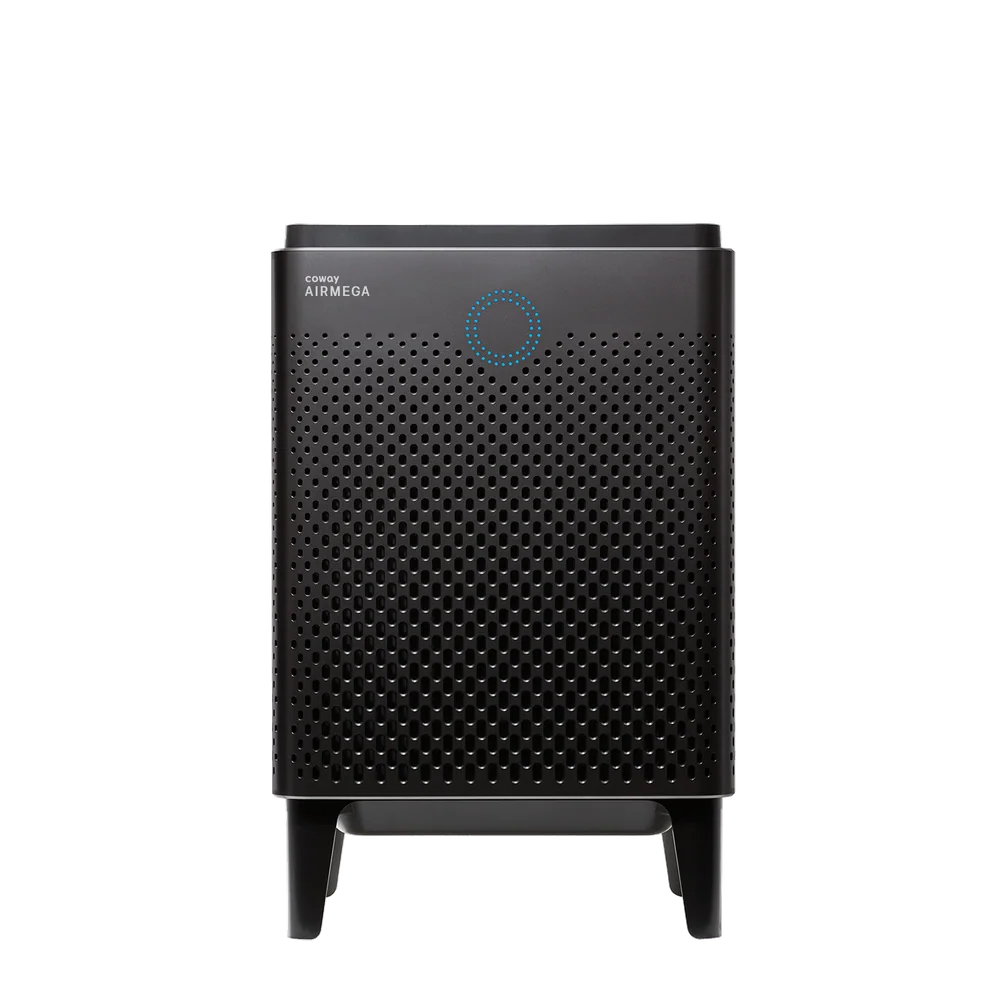
This is not a “hide it behind a plant” purifier. The Coway Airmega 400S is 14.8 x 22.8 x 14.8 inches and weighs 24.7 pounds, so it tends to become a permanent fixture in the room you buy it for. The upside is that it is sized to move enough air for big spaces without needing multiple smaller units.
Controls are flexible. You can use the on-unit interface for basics, and you can also use the app for remote control and for features that are specifically called out as app-based (like the timer and scheduler). If you want to set a daily routine, like running higher during cooking hours and quieter overnight, the scheduler is the cleanest way to do it.
Noise is always the make-or-break issue with large purifiers, because the quietest setting on many machines barely cleans anything. Coway lists a 22 to 52 dB(A) noise range, and the unit includes Sleep mode behavior intended to keep it unobtrusive at night when conditions allow. In real life, that means you are more likely to leave it running instead of turning it off because it is annoying.
Maintenance is straightforward on paper: wash the pre-filters when the indicator tells you, and replace the Max2 filter set when it is due. Coway lists Max2 filter life expectancy at up to one year, and also notes a 6 to 12 month range depending on conditions. Either way, this is the recurring cost you should plan for with any high-capacity purifier.
What to know before you buy
Do not shop this model by the biggest square-foot number alone. Coway’s own spec shows why: 3,120 ft² is based on one air change per hour. If you are dealing with smoke season, heavy allergies, or you just want the air to recover quickly after cooking, you will care more about a higher air-change rate. For this unit, Coway’s two-ACH figure is 1,560 ft².
The smart features are useful, but some of the convenience is app-dependent. Coway lists the timer and scheduler as app features, so if you want a purifier that does everything from the buttons on the unit, you may find the 400S more “connected” than you need.
Finally, plan for the ongoing filter expense. Replacement filters are the main cost of owning any purifier long-term, and some evaluations flag higher operating cost for the Airmega 400S. Even if you love the machine, you should make sure you are comfortable buying the Max2 replacements on schedule.
The specs that matter
Smoke CADR is one of the best quick checks for how fast a purifier can remove smoke-sized particles. A 328 CADR is in the “serious large-room” range and helps you size the unit with more confidence than a vague coverage claim.
If seasonal allergies are a big reason you are buying a purifier, pollen CADR is a useful indicator of how much clean air it can deliver for larger particles like pollen.
That “covers a huge room” headline depends on how many times per hour the air gets cleaned. Two air changes per hour is a more realistic target for keeping a big living space consistently clean.
Washable pre-filters catch hair and larger dust so the main filters last longer. The Max2 combo matters because particles (HEPA) and odors or gases (carbon) are different problems.
A purifier only helps if you can stand to run it. This range suggests it can be very quiet at the low end while still having enough top-end power for quick cleanups.
If you run a purifier for long stretches, watts translate into your electric bill. This number gives you a baseline for what “always on” could cost in your home.
This is a floor unit that wants a dedicated spot. The weight and footprint are fine for a main-room purifier, but not ideal if you planned to carry it between bedrooms.
Who this product fits
You want one purifier for a big living room plus kitchen
The Coway Airmega 400S is designed for exactly this. Its high CADR numbers and large-room ACH specs make it a better fit than buying a small purifier that has to run on high all the time to keep up.
You cook a lot and want the purifier to react automatically
Auto mode uses the built-in particle sensor to adjust fan speed when air quality drops. In practice, that means you can leave it alone and let it ramp up during cooking smoke and settle back down afterward.
You want quieter overnight operation without turning it off
Coway includes a Sleep mode that is designed to run ultra-quiet when the room is dark and the air is already clean. That is the difference between a purifier you actually keep on at night and one you unplug.
You like app control and scheduling
The 400S supports Wi‑Fi control through the Coway Airmega app, and the timer and scheduler are app features. If you want to set routines and check air quality from your phone, this model is built for that workflow.
What else to compare
If the Coway Airmega 400S is close but not quite your style, these are the most sensible pivots.
Coway Airmega 400S FAQ
How big of a room can the Coway Airmega 400S cover?
Coway lists coverage two ways: up to 3,120 ft² at 1 air change per hour, and 1,560 ft² at 2 air changes per hour. For most people trying to control allergies or smoke, the 2-ACH number is the more meaningful one.
What is the Coway Airmega 400S CADR?
Coway lists CADR at 328 for smoke, 328 for dust, and 400 for pollen. CADR is a practical spec for comparing how quickly different purifiers can deliver clean air in a room.
Does the Coway Airmega 400S have a real HEPA filter?
Coway says the Airmega 400S uses Max2 filters that combine activated carbon and HEPA filtration, plus washable pre-filters. The HEPA portion is for particles like dust, pollen, and smoke-sized particles, while the carbon portion is for odors and gases.
Do you need the app to use the Coway Airmega 400S?
You can use on-unit controls for basic operation, but Coway lists the timer (1, 2, 4, or 8 hours) and the scheduler as app features. If you want those conveniences, plan on using the IoCare+ app.
How often do you replace filters on the Coway Airmega 400S?
Coway lists Max2 filter life expectancy at up to 1 year, and also notes a 6 to 12 month range depending on conditions. The unit has a filter indicator to prompt pre-filter cleaning and Max2 replacement.
Is the Coway Airmega 400S quiet enough for a bedroom?
Coway lists 22 to 52 dB(A), and it includes a Sleep mode intended to run ultra-quiet when the room is dark and air quality is sufficiently high. It is physically large, though, so it makes more sense as a main-room unit than a small-bedroom purifier.
Should you buy the Coway Airmega 400S?
Buy the Coway Airmega 400S if you want a large-room purifier that you can leave running without babysitting it. The combination of strong CADR numbers, clear air-change coverage specs, and genuinely useful auto behavior is what makes it feel like a long-term “main room” solution instead of a gadget you fiddle with for a week.
Skip it if you want something compact, or if you do not want app involvement for features like scheduling and timers. But if your goal is simple, consistent air cleaning in a big space, the Coway Airmega 400S is a solid, practical choice.