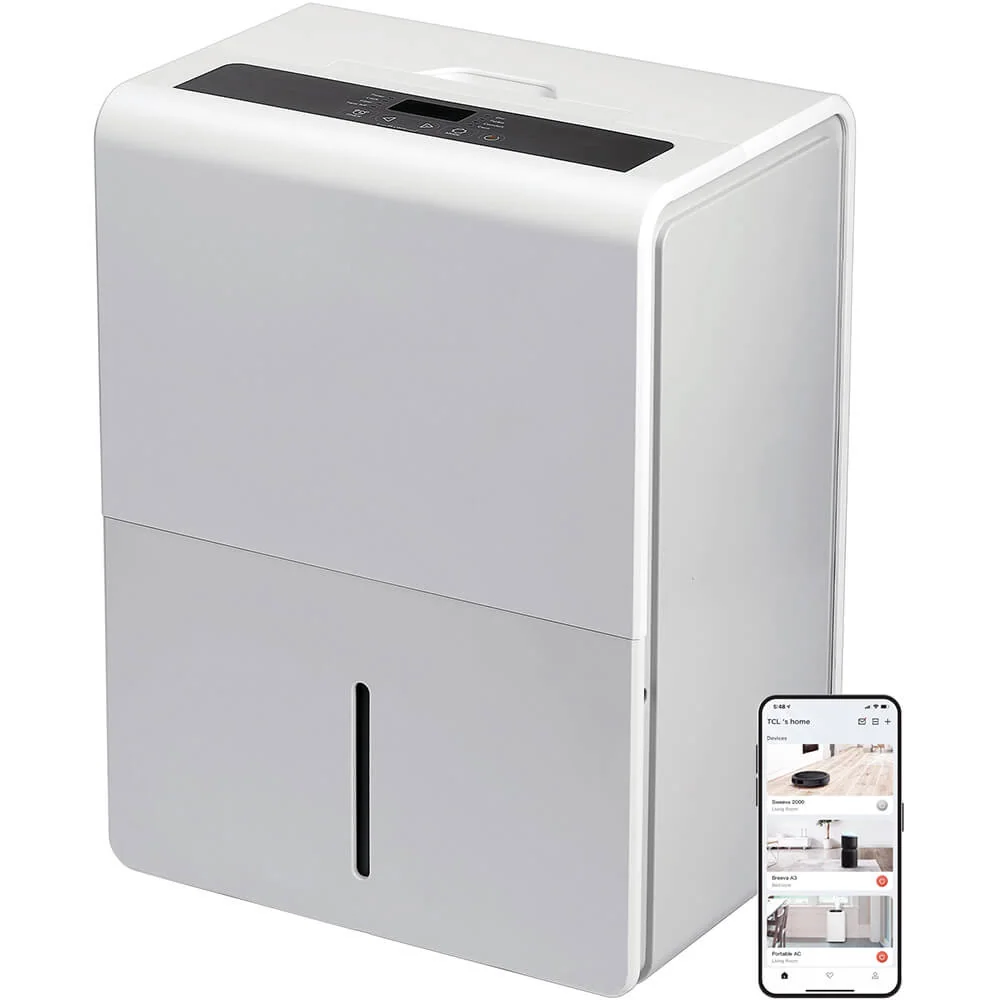
Use watts, compressor runtime, and your local electricity rate to estimate a realistic monthly cost instead of assuming the unit draws full power all day.
The calculation is straightforward: monthly cost equals watts divided by 1,000, multiplied by hours of operation, days, and your electricity price per kilowatt-hour. The hard part is estimating operating time because a humidistat cycles the compressor as the room reaches its target. The examples below use a 500-watt dehumidifier and the June 2026 U.S. residential average of 18.34 cents per kWh reported by the U.S. Energy Information Administration. Replace both numbers with the appliance label and your utility bill for a personal estimate.
Reading time: 8 minutesBest for: Anyone budgeting for dehumidifier electricity use and trying to reduce run time through better moisture control and drainage.
Worked monthly cost examples
Example only: 500 watts, 30 days, and $0.1834 per kWh. Clock time can overstate compressor use after the room reaches its humidity target.
Equivalent full-power hours/day
Monthly energy
Estimated monthly cost
What it represents
4 hours
60 kWh
$11.00
Light cycling after the space is under control
8 hours
120 kWh
$22.01
Moderate daily compressor use
12 hours
180 kWh
$33.01
Heavy moisture load
24 hours
360 kWh
$66.02
Upper-bound continuous full-power assumption
Use the formula with your own numbers
Monthly cost = (watts / 1,000) x full-power hours per day x days per month x electricity rate per kWh. A 500-watt unit running at full draw for eight hours a day uses 120 kWh in 30 days. At 18.34 cents per kWh, that is about $22.01.
Use the listed wattage when available. If the label gives amps but not watts, check the manual or manufacturer specification before relying on volts x amps, which is only an estimate for some appliances. Your utility bill is the right source for the local rate.
Measure runtime instead of guessing
A dehumidifier may be switched on for 24 hours while its compressor runs for only part of that time. ENERGY STAR notes that a built-in humidistat cycles the unit on and off after the target relative humidity is reached. That makes equivalent full-power hours more useful than simple clock time.
A plug-in electricity meter gives the best household estimate because it records actual kWh through compressor cycles, fan operation, defrost periods, and standby. Measure during a representative humid week, then multiply average daily kWh by 30 and by your utility rate.
Compare efficiency using IEF
ENERGY STAR measures dehumidifier efficiency as Integrated Energy Factor, or liters of water removed per kWh. A higher IEF means more moisture removal for each unit of electricity. ENERGY STAR says certified models use 20% less energy than similarly sized conventional models.
Compare units in the capacity class your space actually needs. Capacity is measured in pints removed per 24 hours under defined test conditions. An undersized unit that never reaches the target may run constantly, while proper sizing and moisture-source repairs can reduce operating time.
Reduce moisture before paying to remove it
Close windows and doors while the unit runs, keep airflow paths clear, vent clothes dryers outdoors, use bathroom and kitchen exhaust fans, repair leaks, and direct exterior drainage away from the foundation. ENERGY STAR specifically identifies these steps as ways to reduce humidity or improve operation.
Cold basements also matter. ENERGY STAR warns that below 65 degrees Fahrenheit, frost can form on coils and reduce moisture removal. Choose a model rated for lower temperatures when needed and follow the manufacturer's placement and drainage instructions.
Know when continuous running signals a problem
A unit may run continuously while drying a newly wet space, but weeks of nonstop operation with little humidity improvement can point to an active leak, open-air path, blocked airflow, low-temperature defrost cycling, poor drainage, or incorrect capacity.
Track relative humidity with the built-in humidistat or a separate hygrometer. ENERGY STAR describes 30% to 50% relative humidity as the generally preferred building range; colder climates may need 30% to 40% during heating season to limit window condensation.
What this guide helps you understand
Use measured kWh when possible. The wattage formula is a planning estimate; actual cost depends on compressor cycling, moisture load, temperature, target humidity, and the local electricity rate.
Find the wattage on the appliance label or manual.
Use the cents-per-kWh rate from your utility bill.
Measure actual kWh for a representative week if you need a reliable budget.
Technique notes
At the June 2026 U.S. average residential rate, every 100 kWh costs about $18.34. Local rates can be much higher or lower.
A higher ENERGY STAR IEF means more water removed per kWh, but proper capacity and moisture-source control still determine total runtime.
Safety note: Follow the manufacturer's electrical instructions. Use a properly grounded outlet, keep plugs and cords away from water and drains, and do not use an extension cord unless the manufacturer explicitly permits it.
Sources and methodology
Pickori uses these references for definitions, current standards, and calculations. Product recommendations remain Pickori's interpretation of that evidence.
Dehumidifier buying and efficiency guidanceIntegrated Energy Factor, certified-model efficiency, capacity, humidity targets, cold-weather operation, placement, and moisture-source guidance.